

The biggest risk to progress is not missing one day, but how you react after it happens. One missed workout, skipped writing session, or broken routine doesn’t have to mean much. But if guilt, shame, or “I already failed” thinking takes over, one missed day can quickly turn into two, then three.
In this article, we’ll look at what the 2-day rule is, why it helps with consistency, and how you can use it to keep a small slip from turning into a broken habit.
Key points
- The Core Rule: Never skip a planned activity two days in a row.
- Slip vs. Slide: Missing one day is natural. Missing two days is the start of a new, negative pattern.
- Protect Consistency: Perfection is a trap. The goal is to keep the chain alive, not to overcompensate for a missed day.
- Deploy Your MVO: Use your Minimum Viable Output (the smallest acceptable version of your habit) to survive days with high friction.
- Return Fast: Don’t wait for ideal conditions. Rebuild your momentum immediately, even if the output is small.
Don’t need the theory? Jump straight to the how to here
What is the 2-day rule?
The 2-day rule is simple: never skip a planned activity two days in a row.
Missing one day is inevitable. Maybe you needed recovery, life got unpredictable, or it was just a slip. Missing once is normal. The missed day itself isn’t the issue – how you handle it is. One day is a mistake, but letting it continue into a second and third day creates a new pattern, which is the beginning of the end for your habit.
When you get back on track after a miss, it’ll be tempting to go in with full intensity to make up for it. Don’t. That only increases the risk of more off days later. If time or energy makes it difficult, it’s perfectly fine to return with less intensity just to keep the streak alive. Real growth requires consistency over intensity, and that’s exactly what the 2-day rule helps you achieve.
Why the 2-day rule helps you build better habits
The 2-day rule is an effective strategy for building habits because it prioritizes consistency. While there are several reasons why this framework works, the four most important are:
1. It stops a bad day from becoming a pattern
Skipping once happens. Maybe something got in the way, you needed to rest, or it was just a simple miss. Whatever the reason, the missed day itself isn’t the issue – your response is.
If you respond by letting one missed day become two, and then three, missing becomes your new default. The 2-day rule stops a bad day from becoming a permanent pattern, protecting your habits while they are still being built.
A missed day is normal. Letting it become two is the beginning of a new pattern
2. It protects your identity
Every action you take – and every action you skip – is a small vote cast for your identity. When you are building a new habit, there is almost always a significant gap between what you are currently doing and who you want to be.
Closing that gap requires consistency. It requires casting hundreds of positive votes by showing up even when it’s difficult. Continuously missing days casts votes for the exact opposite identity: someone who withdraws when the pressure is on. The 2-day rule ensures those negative votes can never accumulate, forcing you to stack small wins instead.
3. It forces you to prioritize consistency over perfection
Most of us fall into an all-or-nothing trap. We believe we either have to do a full workout, or stay home with no option in between. We have to execute a flawless workday, or wait until tomorrow. The 2-day rule works against this mindset.
By refusing to miss twice in a row, you learn that you don’t have to show up perfectly – you just have to show up. It is always better to execute your Minimum Viable Output (MVO) consistently than to rely on high intensity sporadically.
4. It removes guilt over a missed day
Missing a day often comes with a heavy guilt or shame. These emotions naturally push us to overcompensate – a reaction that feels logical in the moment, but actively increases the risk of missing again. The 2-day rule provides a clear guideline to accept a miss without overreacting, stripping those difficult emotions of their power.
In the past, when I tried to lose weight, I felt massive shame anytime I veered off the plan. I would try to “catch up” by severely restricting my calories the next day, pushing myself to a point where a complete collapse was the only possible outcome. When I finally succeeded, I had dropped that mindset completely and adopted the 2-day rule. If I slipped up and overate, it still stung, but I didn’t overcompensate. I just followed the 2-day rule and returned to my baseline the very next day. Gradually, I reached my goal, simply because I learned how to survive a small failure without turning it into a catastrophe.
How to apply the 2-day rule to build better habits
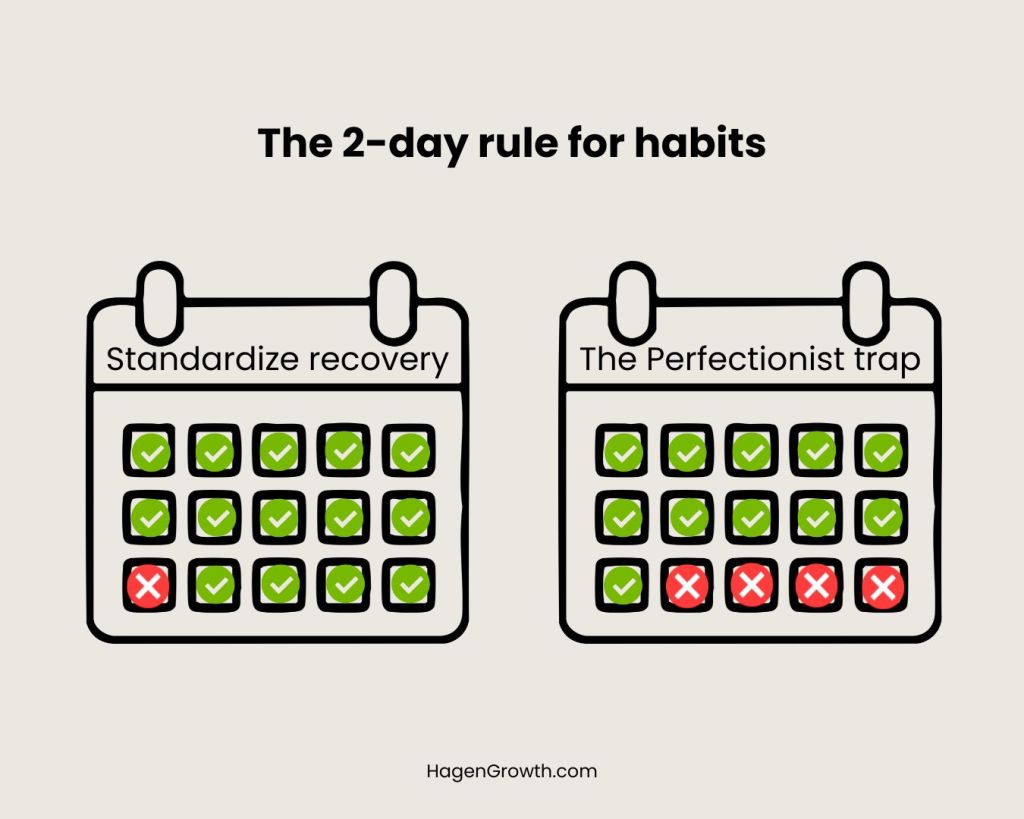
The basic principle behind the rule is simple: never miss two days in a row. If you slip up today, you make sure you get back on track tomorrow.
But while the rule itself is simple, actually living by it when friction hits can be difficult. Here is exactly how to apply the 2-day rule to your life so you never slide.
1. Make the misses visible
To actually apply the 2-day rule, you first need to know exactly what a miss looks like. By defining what success is – even the absolute smallest version of it – you create a clear baseline for what counts as “good enough.” This will remove ambiguity and self-negotiation.
Once that baseline is set, you have to track it. You need an objective system to record whether today was a win or a miss. I personally use a habit tracker. It makes the data visual, highlighting not just your streaks of success, but your days off. This is the safeguard that ensures two empty boxes never sit next to each other.
2. Reflect on why you missed a day
A miss is never just a random event. Even when it feels unpredictable, there is always a reason behind it.
Some misses come from unforeseen challenges: sickness, a power outage, or sudden chaos at work. There is nothing you could have done about these now. The best move is to simply accept the miss and get back on track the next day.
However, most misses are caused by variables entirely within your control. Losing to temptation, forgetting your plan, or rationalizing an excuse – these point directly to a flaw in your system that makes consistency harder than it needs to be.
This is where your tracker becomes a diagnostic tool for reflection. When you record a miss, make a small note of why it happened. If you notice a specific trigger frequently causing you to slip, go into your system and remove that friction. The goal of this reflection isn’t to judge yourself, but to strengthen your systems over time so consistency becomes easier.
3. Define and use your Minimum Viable Output (MVO)
Your Minimum Viable Output (MVO) is the absolute smallest version of a habit you can perform and still count as a success. This is the crucial lever for effectively using the 2-day rule.
Many of our misses happen because we try to do too much. Chances are, the day following a miss won’t be much easier than the day before. If you try to force full intensity on that second day, the risk of overcompensating – or missing again – increases. Instead, you need to set an MVO that keeps the streak alive while still creating long-term progress. You can deploy this MVO to recover the day after a miss, or to prevent a miss in the first place.
I use this strategy constantly. It shifted me from delivering perfectly sporadically to delivering decently all the time, and the results have been massive. Here is what my MVOs look like across my own life:
- Work: My MVO is just 1 focused work block. Over a week, that minimum output is still enough to write an article, draft my newsletter, and wrap up the week.
- Workout: I work out every day, but the duration and intensity scale up or down. For the gym, my MVO is just one exercise per planned muscle group. For biking, the absolute minimum is 30 minutes.
4. Return fast, not perfectly
The fourth and most crucial step is to return fast, not perfectly. Do not let yourself miss a second day just because you are waiting to return with full intensity or be at your best again. The only goal is to show up.
Intensity and perfection do not change who you are, nor do they determine if you reach your goals – long term consistency does. When you miss a day, come back immediately, and accept that you might need to rely on your MVO for a while. Scaling down your output to keep a habit alive is infinitely easier than letting the chain break, fragmenting your identity, and then having to rebuild from zero.
Scaling down to keep a habit alive is always better than having to rebuild from zero
What to do when you miss a day
If you have ambitions, you are going to miss occasional days. There is no way around it. But if handled right, a single miss won’t have any impact on your long-term progress.
Here is a simple, step-by-step guide for what to do when you slip:
- Deploy your MVO: If it’s not too late, use the absolute smallest version of the behavior right now to avoid the miss entirely.
- Reflect and track: If you have already missed, briefly reflect on why and make a small note in your tracker.
- Plan your return: Decide exactly how and when you will return tomorrow. Have your MVO ready if you know your energy or time will be low. The clearer the plan, the better.
- Execute
Further Reading:
- The habit pillar
- Keystone habits
- Identity based habits
- Systems
- Habit tracking
- Small wins
- Selective discipline

- Mindset and Discipline: The Foundation of Sustainable Change - March 4, 2026
- Thinking Vs. Reflection – What is the difference? - February 20, 2026
- Why we do things we later regret – and how to interrupt the pattern - February 13, 2026