

Making real change in our lives is usually a slow process. We have to repeat small actions long before the results become visible. During that process, it can feel like we’re getting nowhere, which makes it harder to stay motivated and keep showing up. A habit tracker can help by making your effort and consistency visible.
Let’s have a look at what habit tracking is, why it works, how to track your habits effectively, and where you can find a free template to get started.
Want the free Habit Consistency Tracker template? Download it here.
Key points
- Habit tracking makes your effort and consistency visible, even before the larger results appear.
- Define a normal version, a minimum version, and a missed day before you begin.
- Use the tracker to notice patterns and improve your system, not only to protect a streak.
- A missed day doesn’t erase your progress. Learn from it and return as soon as possible.
What is habit tracking?
Habit tracking is the process of recording how consistently you perform a behavior. A habit tracker is the tool you use to do this. It can show whether you did the habit, how much you did, and how often you followed through.
Habit trackers can take many different forms. They can be as simple as placing a mark on a Post-it or calendar, or more detailed, such as a habit tracking journal where you also reflect on what helped or got in the way.
On the surface, the purpose is to show how consistent you are. But a good tracker also makes the behavior easier to understand. It gives you a clearer picture of what works, where you struggle, and what you can adjust to become more consistent.
What does a habit tracker record?
A habit tracker can record whether you completed a behavior you want to build or avoided one you want to reduce. Depending on the format, it can show completed days, minimum days, missed days, streaks, and your overall consistency.
This makes patterns easier to spot. You might notice that one missed day is often followed by several others, or that you tend to miss on certain days of the week. If you also note what made the habit easier or harder, the pattern becomes even clearer.
Is habit tracking only about streaks?
Habit trackers are often associated with streaks – and streaks can be motivating. Watching the number grow makes showing up feel more rewarding, while missing a day creates an immediate consequence by breaking it.
But an effective habit tracker should do more than protect a streak. It should help you understand where and why you miss, what supports your consistency, and what you can change.
It can also help you move away from all-or-nothing thinking. Instead of treating perfection as the only successful outcome, you can define a smaller version that still counts on difficult days.
Benefits of habit tracking
Habit tracking is a useful tool for building and breaking habits, but its value goes beyond simply counting successful days. It can make consistency easier, provide small wins, and give you something concrete to reflect on. Here are four of the main benefits.
It makes progress visible
Growth is often slow. It takes many workouts before you notice changes in your physique and many work sessions before you see a business grow. The results of what you do today usually aren’t visible yet.
A habit tracker helps by showing whether you’re consistently doing the behaviors that can create those results. It doesn’t prove that the outcome has arrived, but it makes the effort behind it harder to overlook.
It makes the habit harder to forget
A habit tracker keeps the behavior in front of you. If you place it somewhere visible, it can act as a cue and remind you what you’ve committed to doing.
Even when the tracker isn’t physically visible, knowing that you’ll record the habit later can keep it present in your mind and create a stronger sense of accountability.
It creates small wins
Small wins are the small successes you create when you do something that aligns with your desired identity and long-term goals. They’re small votes of trust in yourself and the direction you’re moving in.
A habit tracker makes these wins visible. As the completed days begin to accumulate, it becomes harder to ignore how often you’ve followed through, which can make each effort feel more meaningful.
Every completed habit is a small vote of trust in the person you’re becoming
It helps you notice patterns
We rarely get anything exactly right the first time. Our plans and systems need iteration: we try something, see how it works, and adjust.
A habit tracker, especially one that includes a few short notes, helps you collect the information needed to do this. When you look back, you may notice which days are harder, what supports your consistency, and what repeatedly gets in the way. This gives you something concrete to reflect on and improve.
How to track habits effectively
There are many ways to track habits, but the most effective approaches tend to do a few things well. They focus on a clear behavior, define what counts so perfection isn’t the only successful outcome, and give you something useful to reflect on later.
Here’s how to build a habit tracking system that does exactly that.
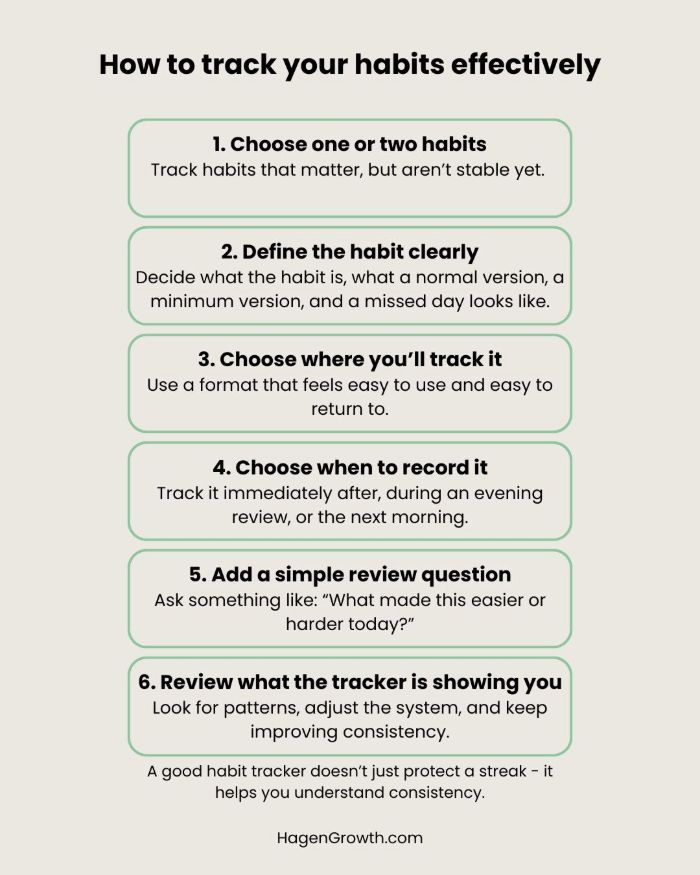
1. Choose one or two habits
Start by choosing one important habit to track. It can be tempting to change everything at once, but doing so often creates overload. You might have a few highly productive weeks, but that usually ends there.
By focusing on one habit, you can give it more attention, learn what supports it, and make the tracking process easier to maintain. Once the habit becomes more stable and requires less conscious effort, you can begin to add another.
Keep in mind that tracking also requires energy. You don’t need to track every habit forever – only while the tracker is helping you stay consistent or learn something useful.
How many habits should you track?
There isn’t a correct maximum. It depends on how demanding the habits are and how detailed your tracking system is. However, if tracking begins to feel like a separate project, you’re probably trying to follow too many things at once.
When you want to add a new habit, consider removing one that has already become stable or no longer provides useful information.
Which habits are worth tracking?
The best habits to track are usually those that are important to you but not yet as consistent as you would like.
These may be keystone habits that influence several parts of your life, but they don’t have to be. A habit is worth tracking when improving it would make a meaningful difference and when the tracker can help you understand why you struggle to follow through.
It can be tempting to track habits you already perform consistently because they provide easy wins. There’s nothing wrong with doing that briefly, but it’s rarely the best use of your attention. In most cases, the highest value comes from tracking habits that matter and still need work.
Habits you may want to build include:
- Working out
- Following a sleep schedule
- Reading
- Taking daily walks
- Meditating
- Journaling
Behaviors you may want to reduce include:
- Eating junk food
- Going to bed later than planned
- Mindless scrolling
- Snoozing
- Overspending on unnecessary things
- Using your phone late at night
These are still broad categories rather than clearly defined habits. Before you begin tracking, you need to decide exactly what the behavior looks like and what counts as showing up.
2. Define the behavior clearly
The more clearly you define the behavior, the easier it becomes to track and understand. You should know what you expect yourself to do, what still counts on a difficult day, and what a genuine miss looks like.
So instead of simply deciding that you want to track meditation, define a normal version, a minimum version, and a missed day. You can then assign a color or symbol to each outcome so the pattern is easy to see later.
How strict these versions should be depends on you and your goal. But it’s usually a good idea to leave some room for difficult days. That means accepting that you can’t give 100% every day, and that showing up imperfectly is often better than waiting for ideal conditions and doing nothing.
Define a normal version
Your normal version is what you expect yourself to do on most days. It should be meaningful enough to create progress over time, but still realistic enough to repeat consistently.
For a meditation habit, the normal version could be completing a 10-minute guided meditation.
Define a minimum version
Your minimum version is a smaller version of the same habit that you can use when the normal version doesn’t fit the day.
It should be easy enough to remain realistic when you’re tired, busy, or under pressure, but still meaningful enough to maintain your connection with the habit to avoid turning one difficult day into a pattern of not showing up.
With the meditation example, the minimum version could be spending one minute focusing on your breath while sitting on the couch.
A minimum output day isn’t a failed normal day, but a successful day for keeping consistency
Decide a missed day
Finally, decide what counts as a missed day. This usually means completing neither the normal nor the minimum version.
For the meditation habit, that could mean not taking any intentional moment to sit, breathe, and bring your attention back to the present.
3. Choose your tracking format
Next, choose where and how you’ll track the habit. The right format should create as little friction as possible, make it easy to record both successful and missed days, and give you enough information to reflect on later.
Which format works best depends on you, the habit, and how much detail you need. Some trackers are designed for quick check-ins, while others give you more space to understand what helped or got in the way.
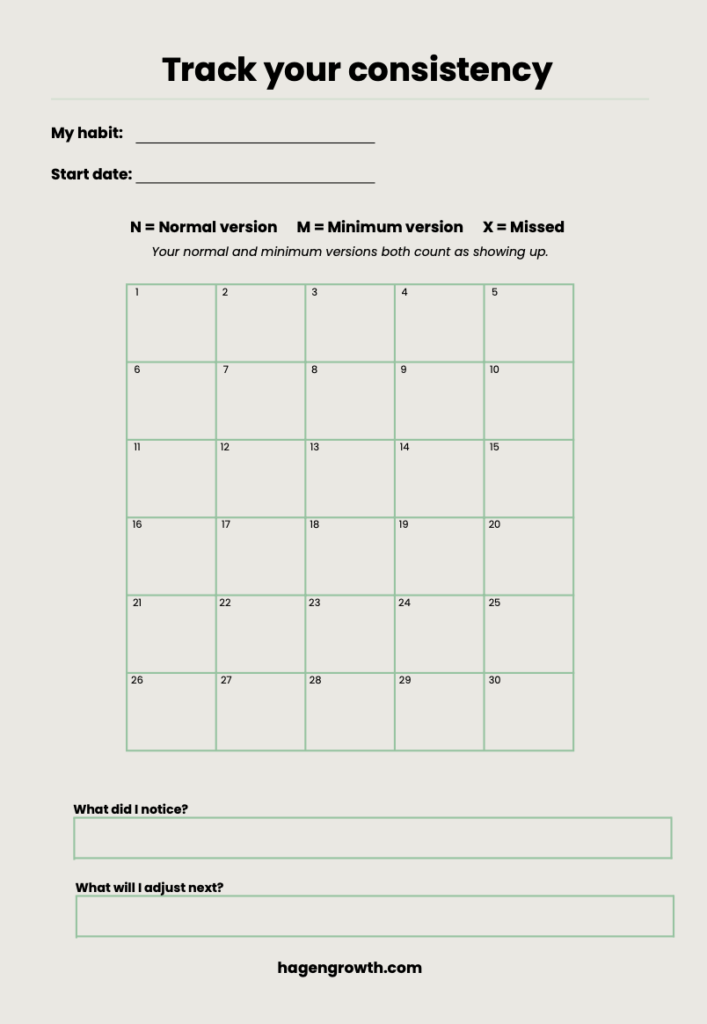
A fillable or printable habit tracker
A fillable or printable habit tracker is a ready-made PDF that you can use digitally or with pen and paper. Depending on how it’s designed, it can combine simple daily tracking with prompts that help you reflect on your efforts and patterns.
Because the structure is already created for you, it’s easy to begin. You can often reuse the same template for different habits or start again once the tracking period is complete.
The main limitation is that you have to work within the design of the tracker. But when the format fits your needs, it can work well for both simple habits and those that require more reflection.
A calendar
A calendar can be used as a simple habit tracker by placing a mark on each day you complete the behavior. It provides a clear visual of how consistently you’re showing up and takes very little time to maintain.
The limitation is that a calendar rarely gives you much room for context. It works best for straightforward habits, such as flossing or taking a daily walk, unless you combine it with a separate place for notes.
A habit tracking journal
A habit tracking journal places more emphasis on reflection. Alongside recording whether you completed the habit, you can note what you did, how it felt, what helped, and what caused a miss.
This gives you a more detailed understanding of your behavior, but it also requires more time and effort than a simple tracker. It’s often most useful for habits where consistency is difficult or where understanding the reasons behind your actions matters.
A spreadsheet
A spreadsheet can work like a digital calendar, with dates across the top and habits listed down the side. You can mark each day with a color, symbol, or short note.
It can also be adapted to track details such as minutes spent, pages read, or which version of the habit you completed. This makes spreadsheets flexible, although a more advanced setup may take time to create and maintain.
A habit tracking app
A habit tracking app lets you record habits directly on your phone. Many include reminders, progress summaries, streaks, and different ways to organise the behaviors you’re working on.
Apps are convenient because your phone is usually nearby, but that can also be a drawback. Opening the tracker may place you next to notifications, scrolling, and other distractions. How much room you have for reflection will also depend on the app you choose.
The best tracking format is usually the simplest option that gives you the information you need and that you’ll continue using.
The best habit tracker isn’t the one that gives you useful information and that you’ll keep using
4. Choose when to record the habit
Once you know which format you’ll use, decide when you’ll record the habit. Having a fixed time makes tracking easier to remember and helps it take as little attention as possible.
There are three common times to do it. Which one works best depends on the habit and how your day is structured.
Immediately after the habit
Recording the habit immediately afterwards is often the easiest option. The behavior is still fresh in your mind, the check-in creates a small sense of completion, and you close the loop before moving on.
This works especially well for good habits such as reading, meditating, exercising, or writing. It’s less practical for behaviors you’re trying to avoid, as you may only know whether you succeeded once the day is over.
During an evening review
An evening review works well when you prefer to track several behaviors at once or want to add a short reflection about the day.
If you already have an evening routine, you can attach the review to something you do consistently, such as preparing for the next day or writing in a journal. This makes the tracker easier to remember and gives you a chance to look at the day as a whole.
The following morning
You can also record the habit the next morning. This can work well for behaviors that happen late in the day, such as following a bedtime, limiting evening screen use, or avoiding mindless scrolling in bed.
The main risk is forgetting details from the previous day, so it helps to make the review part of an existing morning routine.
5. Add a simple review question
Before you begin, add one simple question that helps you reflect on what the tracker is showing you.
The question can be answered each day, once a week, or at the end of the full tracking period, depending on how much detail you need. It should be simple enough that reflection doesn’t become another demanding habit.
For example:
- What made the habit easier or harder?
- What did I notice?
- What repeatedly got in the way?
- What will I adjust next?
The purpose isn’t to analyse every day in depth, but to give the marks on your tracker enough context to become useful.
6. Review what the tracker is showing you
After using the tracker for a while, take time to look beyond the individual days and review the pattern as a whole.
How often you do this depends on the habit and the format. You might briefly check your tracker each week and then complete a fuller review after 14 or 30 days. The period should be long enough for patterns to appear, but not so long that you forget what was happening around them.
Use your review question to consider what helped, what repeatedly caused misses, and whether your normal or minimum version needs to change.
Then act on what you’ve learned. If the habit is still unstable, adjust the system and continue tracking. If it has become consistent and the tracker is no longer teaching you anything useful, you can reduce the amount of tracking or move your attention to another habit.
A habit tracking example
Let’s make the system more concrete with an exercise habit.
Habit: Exercise regularly
Normal version: Complete the planned workout
Minimum version: Walk or do mobility work for ten minutes
Missed day: Complete neither the normal nor minimum version
Format: Fillable habit tracker
Tracking time: Immediately afterwards
Review question: What made exercise easier or harder this week?
A week could look like this:
- Monday: Normal version
- Tuesday: Normal version
- Wednesday: Minimum version
- Thursday: Missed day
- Friday: Normal version
- Saturday: Normal version
- Sunday: Planned rest
Wednesday still counts as a successful consistency day. The full workout wasn’t realistic, but the minimum version kept the habit active without demanding more than the day allowed.
Thursday remains visible as a missed day, but it doesn’t erase the progress made earlier in the week. It simply gives you something to reflect on. Maybe the workout was poorly timed or the minimum version was still too demanding.
Sunday doesn’t count as a miss because rest was part of the plan. A tracker should measure whether you followed the habit you defined, not punish you for days when the behavior was never expected.
At the end of the week, the review question helps you look beyond the individual marks and understand what supported your consistency, what made it harder, and what you may need to adjust.
Free printable and fillable habit consistency tracker template
Enter your email below and I’ll send you the free 30-day Habit Consistency Tracker. Use it to define your normal and minimum versions, plan how you will recover after a miss, and track how you stay consistent when life doesn’t go as planned.
*By entering your email, you agree to receive emails from Hagen Growth. I’ll send you the template and weekly reflections. You can unsubscribe at any time.
What happens when you miss a day?
At some point, you’re likely to miss a day. Maybe the day was poorly planned, you were overwhelmed, or something unexpected got in the way.
One missed day doesn’t mean the habit has failed. What matters most is how you interpret the miss, what you learn from it, and how quickly you return.
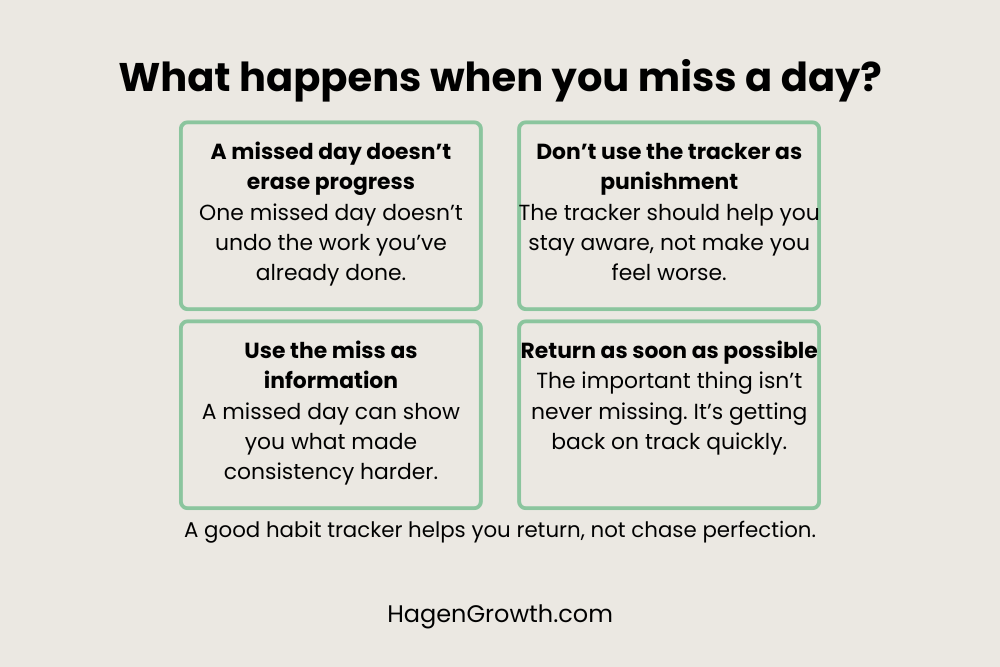
A missed day doesn’t erase your progress
One missed day doesn’t destroy what you’ve already built or mean that you have to start over. The previous repetitions still happened, and the progress you made before the miss still counts.
So accept the miss for what it is: one day where you didn’t follow through. Don’t turn it into proof that you’re incapable of being consistent or that the whole effort was wasted.
Don’t use the tracker as punishment
Breaking a streak can be frustrating, but the tracker shouldn’t become a tool for punishing yourself.
Trying to compensate with an extreme effort, making yourself uncomfortable, or becoming overly harsh rarely helps. It can make difficult emotions become associated with the habit and the tracker, which only makes avoidance more likely.
The purpose of tracking is to give you an honest picture of what happened, not to judge your worth or discipline.
Use the miss as information
Not every missed day needs a deep explanation. Sometimes life simply gets in the way. But if the same situation repeatedly causes you to miss, there’s probably something worth paying attention to.
Maybe misses follow certain emotions, happen when you’re tired, or appear because the normal and minimum versions are still too demanding. Looking at these patterns and taking responsibility without blame, helps you improve the system instead of repeatedly assigning blame.
A miss can be frustrating, but it can also show you where your approach needs to become more realistic.
Return as soon as possible
Finally, return as soon as you can. Don’t let one missed day become the beginning of a longer pattern of not showing up.
Ideally, return the next day, even if that means using the minimum version. The goal is to rebuild the rhythm and continue becoming someone you can trust to show up for yourself.
Consistency isn’t about not missing, but learning from the miss and returning before it becomes a pattern
Final thoughts
A habit tracker does more than protect a streak. It makes your behavior visible and shows what consistency looks like on normal days, difficult days, and the days when you miss.
The real value is what you learn from it. When you understand what helps you show up, what gets in the way, and what needs to change, you can adjust your approach and make the habit more stable over time.
This is how you gradually improve your systems and, through enough iterations, create more sustainable consistency.t be difficult at first. But as you find something that works for you and gets into the habit, it’ll be an invaluable tool.
Further reading:
How to Make Meditation a Daily Habit

- Mindset and Discipline: The Foundation of Sustainable Change - March 4, 2026
- Thinking Vs. Reflection – What is the difference? - February 20, 2026
- Why we do things we later regret – and how to interrupt the pattern - February 13, 2026