

A small habit is a behavior that takes little time and no more than a step or two, which is what makes it easy to repeat consistently. Below are 27 of them, along with what makes a small habit work and why the small ones tend to hold when the big ones don’t.
We often look for something big when we want to grow. A big habit, a big effort, or a big change that will finally move everything forward. But most growth doesn’t begin there. It begins with the small behaviors you repeat often enough that they become part of your normal life.
Key points
- Small habits are simple, repeatable behaviors that are easy to fit into your normal day.
- They matter because they give you small wins, build self-trust, and make progress easier to repeat.
- Small habits may not feel life-changing in the moment, but they compound over time when done consistently.
- The best small habits are easy to start, clear enough to repeat, and connected to the kind of person you want to become.
Chosen a small habit to start with? Learn how to track it and see your progress
What makes a habit small enough?
A habit is small enough when you’d still do it on your worst day, not just the good ones. The day you’re tired, overwhelmed, or just don’t feel like it. If it only survives good days, it isn’t really a small habit.
Earlier, staying hydrated used to be a big issue for me. I would rarely drink enough, and often, I would be up for several hours before I even had my first glass. I often tried to just “drink more”, but that never worked.
Instead, I formed a small habit of drinking a large glass of water first thing in the morning. The immediate impact wasn’t big, I had a bit more energy, but over time, that one glass quickly spread out across the day, and became several small habits.
A small habit can be a habit on its own, such as making your bed in the morning, or be part of a larger habit, such as packing your gym bag the night before so it becomes easier to work out the next day.
I often tried to just “drink more”. That never worked. One glass, first thing in the morning, did.
Why small habits make a big difference
Small habits can make a big difference because they are easy to repeat. One small behavior will not change much on its own, but when it becomes part of your normal routine, it starts to shape how you act, think, and follow through.
They give you small wins
You get a small win every time you do something that moves you in the right direction. The behavior itself matters, but the win also changes how you see yourself. It gives you proof that you can follow through, even when the action is small.
Small habits are a good way to collect these wins because they are simple enough to repeat consistently. This is especially useful in the beginning, when belief is often low and you need evidence that you are actually changing.
It gives you proof that you can follow through, even when the action is small.
They’re easier to repeat
Small habits don’t take much time or effort. They’re usually quick, simple, and easy to fit into a normal day. That makes them easier to repeat, which gives them a better chance of becoming part of your routine.
They can also support bigger habits. If going to the gym feels difficult, packing your gym bag the night before is a small habit that makes the larger habit easier to start. You aren’t doing the whole thing at once, but making the next step easier.
They compound over time
Small habits rarely feel life-changing in the moment. Making your bed once, reading one page, or taking the stairs will not transform your life overnight.
But repeated over time, these behaviors start to add up. They create more structure, more movement, more follow-through, and more evidence that you are becoming the kind of person who acts on what matters.
Taking the stairs instead of the elevator brings you closer to getting in shape. Five minutes of writing brings you closer to finishing the project. Reading one page brings you closer to finishing the book.
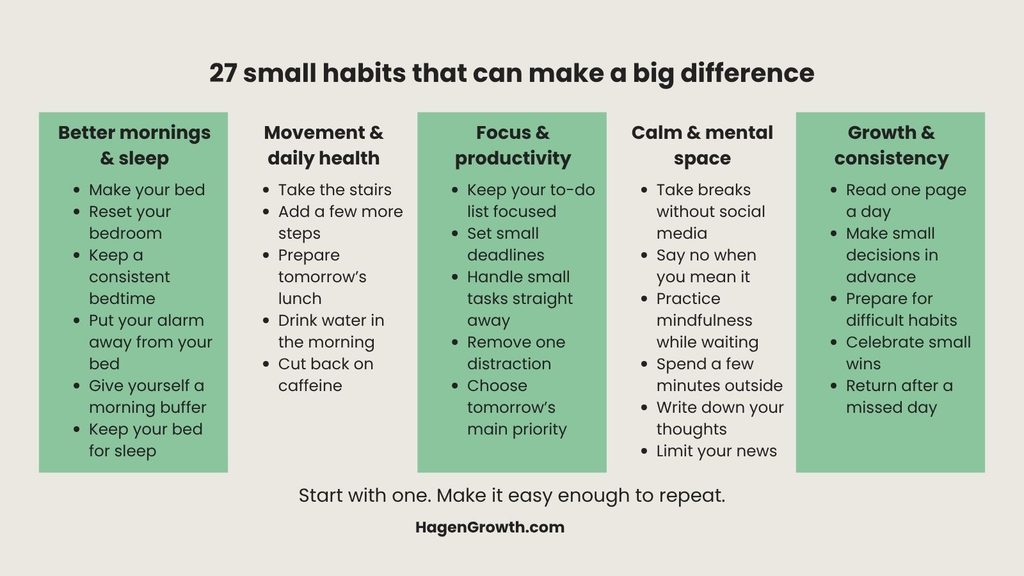
27 small habits that can make a big difference
Here are 27 small habits that can make a big difference in your life.
1. Make your bed
Making your bed in the morning is one of the most popular small habits, and for good reason. It’s quick, has a clear anchor, and gives you a small win early in the day.
That doesn’t mean making your bed will magically make the whole day better. But it can give you a simple moment of follow-through before the day really begins.
2. Keep only the essentials on your to-do list
A messy to-do list is rarely useful. Instead of helping you prioritize, it can become another source of stress because everything looks equally important.
Keep only the essentials on your main to-do list. If you need somewhere to put everything else, create a separate list for the mess. That way, your main list stays focused on what actually needs your attention.
3. Set small deadlines
When there is no deadline, it is easier to drift. The task stays open, motivation changes, and things often take longer than they need to.
Set small deadlines for yourself, especially on tasks that are easy to postpone. The goal is to create a clear point where you have to act, finish, or move forward.
4. Avoid social media during breaks
Most people reach for their phone when it’s time for a break, but scrolling doesn’t give you real rest. Your attention is still active, and your mind is still taking in more input.
If you want a better break, let it actually be a break. Stand up, walk around, look out the window, or sit without filling every empty moment. A little boredom can be useful.
5. Read one page every day
Reading is a great habit, but it can feel harder to start when you expect yourself to read a full chapter every time.
Reading one page lowers the barrier. It gives you a natural starting point, and if you want to continue, you can. If not, you still kept the habit alive.
6. Reset your bedroom before bed
Make sure your bedroom is relatively tidy before going to bed. It doesn’t have to be perfect, but a cluttered room can make it harder to feel calm.
A brief evening reset is often enough. Put away the obvious mess, clear the floor, and make the room feel like a place where sleep is the next natural step.
7. Take the stairs when possible
Taking the stairs instead of the elevator is a simple way to add a bit more movement to your day.
You don’t have to take the stairs every single time. Set a default that makes sense for you. For example, if it is only one or two floors, take the stairs. Over time, small defaults like this add up.
8. Add a few more steps throughout your day
A common target is 8,000–10,000 steps a day, but that isn’t realistic for everyone, and you don’t need to force a perfect step count from day one. A better place to start is simply adding a few more steps where they naturally fit in your day.
Park a little further away, take a short walk during a break, or walk to the shop instead of driving if it’s close enough. None of these seem like much on their own, but they can make movement a more normal part of your day.
9. Say no when you want to say no
Saying yes to things you don’t want to do can quickly take energy away from the things that actually matter to you.
You don’t have to say no to everything or be harsh about it. But when something clearly doesn’t fit your values, capacity, or priorities, saying no can be a small habit that protects your time and energy.
10. Set a consistent bedtime
Most adults need somewhere around 7-9 hours a night, but when you sleep matters too. Your body works better when your sleep has some rhythm. Going to bed and waking up around the same time makes it easier for your body to know when it’s time to sleep and when it’s time to be awake.
It doesn’t have to be perfect every night. But even a fairly consistent bedtime can make your evenings feel more stable and your mornings easier.
11. Put your alarm away from the bed
Snoozing is tempting because it feels like you are getting a little more rest. But for many people, it just makes the morning slower and more fragmented. It can even make you more tired throughout the day, even if you got more sleep.
Putting your alarm away from the bed gives you one clear job when it rings: get up. Once you are already standing, it becomes easier to stay up and start the day.
12. Give yourself a small morning buffer
Your morning often sets the tone for the rest of the day. When you start the day rushing, it’s easy to carry that stress with you.
Give yourself a small buffer in the morning if you can. It could be ten extra minutes to eat, get ready, or just start the day without immediately feeling behind.
13. Make small decisions in advance
When you make decisions in the moment, it’s easy to choose whatever feels easiest right now. That’s not always the option that supports what you actually want.
Make small decisions in advance. Decide when you’ll go to the gym, what you will eat for lunch, or when you’ll start your work session. When the decision is already made, the better option becomes easier to follow.
14. Prepare for difficult habits the day before
The more steps there are before a difficult habit can begin, the easier it becomes to skip it.
Prepare for the habit before you need it. Pack your gym bag, lay out your clothes, prepare your workspace, or place the book where you plan to read. The goal is to make the habit easier to start when the moment comes. Ideally, it should take no more than 20-seconds.
15. Prepare lunch the day before
Preparing lunch the day before makes it easier to eat in a way that supports you, especially when the day gets busy.
Even a simple lunch prepared in advance removes one decision from the next day and makes the better choice more convenient.
16. Drink a glass of water in the morning
Even mild dehydration can show up as fatigue, trouble concentrating, and low mood. Often, we are already behind when we wake up in the morning after a night without fluids.
Drinking a glass of water when you get up is a simple way to start the day well. It gives you an easy win, and it’s quick, repeatable, and easy to connect to something you already do. And, it makes you more energized.
17. Meditate while waiting
Most people reach for their phone whenever they have a few empty seconds. Waiting in line, sitting on the toilet, standing between tasks, or waiting for the kettle to boil.
You can use some of those moments differently. Take a few breaths, notice how your body feels, and pay attention to what is going on in your mind. It’s not a full meditation session, but it can still give you a small moment of awareness instead of more stimulation.
18. Get outside for a few minutes
This might not be possible for everyone, but if it is, I recommend trying to get out and enjoy nature every day. Going for a small walk, or just sitting quietly where there’s green or water. Step outside, get some fresh air, and feel the weather.
If going outside is not realistic, airing out your space can still help change the environment around you.
19. Cut back on caffeine
Caffeine can be a useful tool for productivity and performance, but it’s easy to start relying on it too much. If you use it every time you feel tired, it can become something you need just to feel normal.
You don’t have to remove caffeine completely, but cutting back, using it more deliberately, or replacing one coffee with water can help you depend on it less and notice your natural energy.
20. Do small tasks straight away
Some tasks become more annoying the longer they sit around. Answering a simple message, paying a bill, putting your dishes away, or moving something back where it belongs often takes less energy now than later.
If a task takes less than two minutes and you aren’t in the middle of something more important, do it straight away. It keeps small tasks from turning into mental clutter.
21. Write down your thoughts every night
Take a few minutes at night to write down what’s on your mind. It doesn’t have to be structured, polished, or even useful to anyone else.
The point is to get lingering thoughts out of your head and onto the page. This can help you understand yourself better, reduce mental clutter, and end the day with a little more clarity.
22. Limit the news you read
It is reasonable to stay informed, but constantly checking the news can take up more mental space than it deserves.
Limit how often you read the news, choose sources that don’t constantly pull you into fear or anger, and focus on what actually matters to you. You don’t need to be updated on everything all the time.
23. Celebrate small wins
Small wins matter more when you actually notice them. If you always move on to the next thing without acknowledging what you did, the progress can become easy to miss.
Take a moment to recognize when you follow through. You can simply pause and acknowledge it, write it down, or give yourself a small reward. The point is to make the win visible.
24. Remove one unnecessary distraction
There are always things pulling at your attention. Apps, notifications, clutter, entertainment, open tabs, unfinished tasks, and other people’s priorities.
Remove one unnecessary distraction. Put your phone in another room, close one tab, delete one app, or clear one part of your workspace. Small reductions in distraction can make it easier to focus on what matters.
25. Write down one priority for tomorrow
Before the day ends, write down one priority for tomorrow. Not everything you need to do, just the one thing that matters most.
It could be a specific task, a workout, a conversation, or even taking the day slower. When you write it down, you give your mind something clear to return to when the next day becomes busy.
26. Keep your bed for sleep
Your mind quickly connects places with behaviors. If your bed becomes a place for work, scrolling, entertainment, and sleep, it can become harder to fully switch into rest.
Keep your bed for sleep when possible. This gives your body a clearer signal that being in bed means it is time to wind down, not work, scroll, or stay mentally active.
27. Never miss two days in a row
Everyone misses a day once in a while. What matters when it happens is how you respond.
When you miss once, accept it and get back on track the next day. The 2-day rule helps you avoid turning one missed day into a new pattern.
A habit is small enough when you’d still do it on your worst day, not just the good ones.
Final thoughts
When we think about growth, we often focus on the big habits. Going to the gym, doing the work, and learning new skills. Those habits matter, but they’re often supported by much smaller behaviors.
Small habits may not look impressive on their own, but they make it easier to get started, stay consistent, and build trust in yourself. Use them to support the bigger habits, gather small wins, and make progress feel more repeatable.
Over time, the small behaviors that seemed insignificant can become part of how real change happens.
What’s worth changing first?
Before adding another habit, take a closer look at the ones you already repeat. The free Habit Scorecard can help you spot which habits support you and which you’d like to change.

- Mindset and Discipline: The Foundation of Sustainable Change - March 4, 2026
- Thinking Vs. Reflection – What is the difference? - February 20, 2026
- Why we do things we later regret – and how to interrupt the pattern - February 13, 2026