

Personal productivity is how well you use your time, energy, and attention to make progress on what actually matters to you. It has three parts: how much you produce, how good it is, and what it costs you to produce it. Improving it comes down to managing five things: direction, attention, energy, execution, and review.
When I first started Hagen Growth, I thought being in constant motion meant that I was productive. I would overplan and spend my time trying to make everything perfect. But as a result, I didn’t produce much, the work I made wasn’t that great, and it cost me way too much energy.
I then started to look at productivity not as an action, but an output. For a day to be productive, I demanded an actual tangible progress that would move my work forward. Because what I realized was that if it doesn’t bring me closer to what I’m trying to achieve, it’s not productive.
Key points
- Personal productivity is about meaningful progress, not just doing more.
- The three types of productivity are quantity, quality, and efficiency.
- Busy work keeps you active. Productive work moves you closer to a goal.
- Personal productivity depends on direction, attention, energy, execution, and review.
- You can improve it by planning better, reducing friction, protecting focus, and reviewing what works.
- Common productivity mistakes include multitasking, skipping sleep, and staying busy without direction.
Next step: Make the work that matters easier to repeat, by creating a strong system around it.
Busy and productive aren’t the same thing
Being busy and being productive can look similar, but they aren’t the same. Being busy means you are doing a lot. Being productive means you’re doing things that actually move you closer to a meaningful goal.
This matters because busy work can feel productive. You might tweak small details, reorganize your workspace, check messages, rewrite your to-do list, or stay constantly active without making real progress.
Busy work is the most socially acceptable form of procrastination there is
For something to be productive, it should usually do at least one of two things:
- help you learn something useful
- create small but noticeable progress toward your goal
Busy and productive can overlap, but activity alone isn’t the goal. It’s better to do the right things consistently than to fill your day with tasks that only make you feel productive. Be honest with yourself about which role your activities have.
This also means productivity depends on context. A task is not automatically productive just because it keeps you busy. For something to be productive, it needs to move you closer to a goal, teach you something useful, or support the life you are trying to build. If it doesn’t, it may just be busy work.
In the Hagen Growth philosophy, productivity is an application of behavior and systems. The point is to use your time, energy, and attention in a way that supports the life you are trying to build.
The 3 types of personal productivity

To be truly productive, you need more than just “getting things done.” Personal productivity depends on three types of output: quantity, quality, and efficiency.
These three types work together. If one is missing, your productivity becomes incomplete.
Quantity
Quantity is how much work you produce. It can be measured by the number of tasks completed or the amount of progress made on a larger task.
For example, it could be the number of words written, social media posts scheduled, emails answered, workouts completed, or sections of a project finished.
Quality
Quality is how good, useful, or valuable your output is.
It isn’t enough to simply produce a lot if the work doesn’t help you or others in a meaningful way. One high-quality article, report, workout, or project can often be more productive than several low-quality ones.
Efficiency
Efficiency is how well you manage your resources, especially your time, energy, and attention.
It looks at what you produced compared to what it cost you. If a small task drains a lot of energy, your efficiency is low. If you complete important work while still having energy left for the rest of your life, your efficiency is higher.
Why you need all three
| Missing | What you get |
| Efficiency | Good work, but it’s produced at a cost you can’t sustain. |
| Quality | A lot of output, but it isn’t worth much. |
| Quantity | Good work, but you don’t do enough to make actual progress |
At times, one type may need more focus than the others. But over time, strong personal productivity requires all three: enough output, good enough output, and a sustainable way to produce it.
Why personal productivity matters
Personal productivity matters because most goals require repeated action over time. It’s the process of doing the right work consistently enough for the results to accumulate.
If you want to grow a business, get better grades, improve your health, train for a sport, build a creative project, or create more time for the people and hobbies you care about, productivity matters. Your time, energy, and attention need to be used well enough to move you in the direction you want to go.
The core parts of personal productivity
Personal productivity depends on five core parts: direction, attention, energy, execution, and review. These are the things you need to manage if you want to become more productive. There is overlap between them, but each plays a different role.
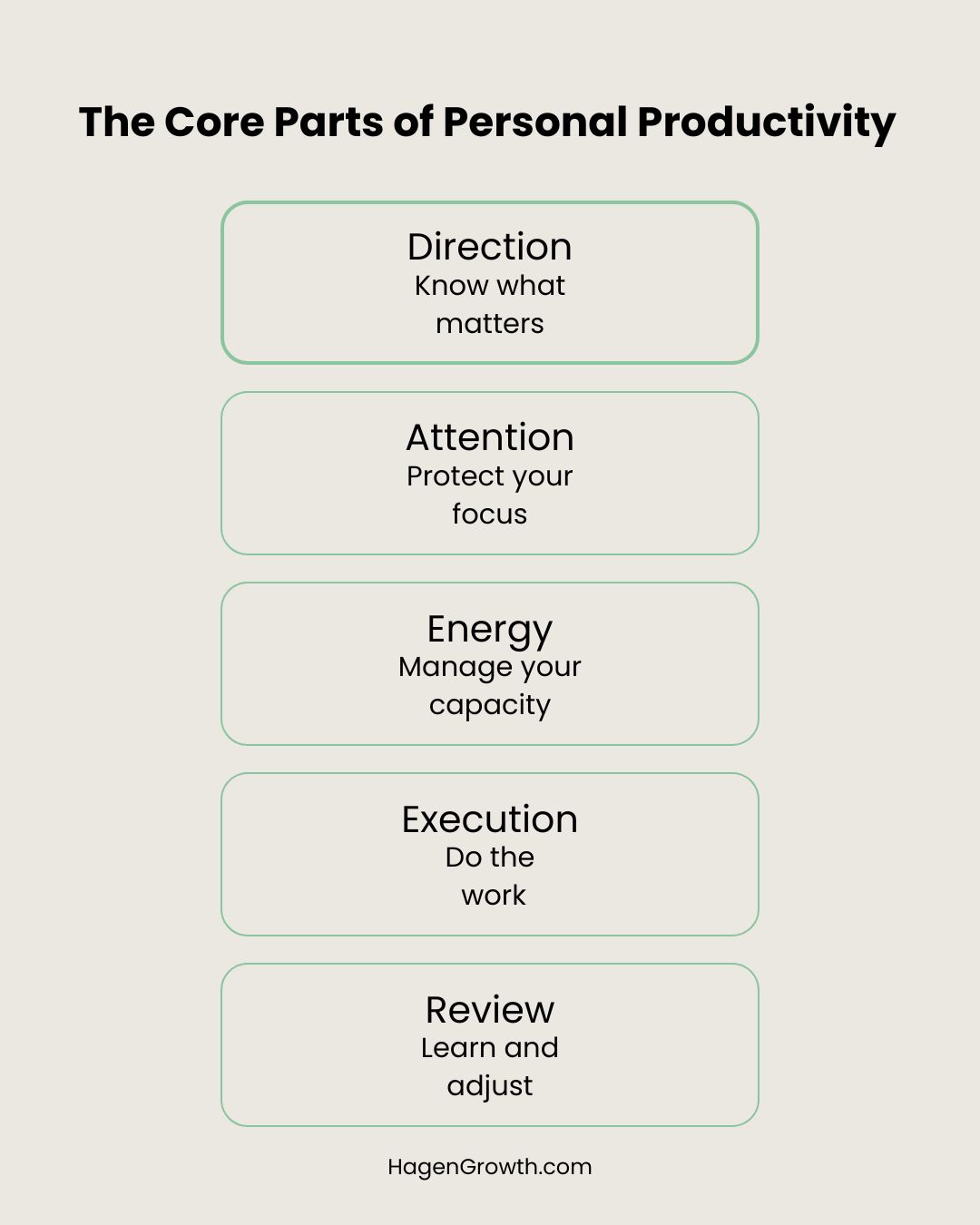
Direction
Direction is about knowing what matters and where you are trying to go.
Without direction, it’s easy to stay busy without making meaningful progress. You may complete tasks, answer messages, or work for hours, but if the work does not support your goals, it will not move you far. Direction helps you decide what deserves your time and energy.
Attention
Attention is about staying focused on the right thing long enough to do meaningful work.
It’s not just about avoiding distractions, but also choosing what not to give your attention to. If everything gets access to your focus, the important work becomes harder to finish.
Good personal productivity requires protecting your attention so it can be used where it matters most.
Energy
Energy is about having the physical and mental capacity to work well.
You may know what to do and have the time to do it, but if your energy is low, your output will suffer. Sleep, food, exercise, stress, breaks, and emotional load all affect how much productive capacity you have.
Execution
Execution is about actually starting and doing the work – it’s what turns intention into progress.
Planning, thinking, and organizing can support productivity, but they aren’t the same as execution. At some point, the work has to happen. This is where procrastination, friction, fear, and avoidance often show up.
Review
Review is about learning from what happened and adjusting your approach. It helps you improve your productivity over time instead of relying on guesswork.
Without review, you can stay stuck in the same patterns without understanding what works and what doesn’t. You may repeat the same mistakes, use the same weak schedule, or keep pushing through a method that doesn’t fit your life anymore.
Personal productivity starts with direction. Without knowing what matters, effort has nowhere useful to go
How to improve personal productivity
Personal productivity can be improved with practice, reflection, and better tools. It depends on your context, goals, energy, and current habits, so there is no single method that works for everyone. But there are several principles that can help you use your time, energy, and attention better.
Clarify what actually matters
If you work on too many things at once, your time and energy get spread thin. You may stay busy, but it becomes harder to make meaningful progress on anything.
Start by clarifying what actually matters to you. What are you trying to build, improve, finish, or move toward?
The clearer your direction is, the easier it becomes to be productive. If several things matter, prioritize them. Not everything can receive the same amount of energy at the same time.
Use the right techniques to beat procrastination
Procrastination is one of the biggest problems for personal productivity. It makes it difficult, and sometimes almost impossible, to start the work that matters.
The mistake many people make is assuming procrastination is only laziness. Then they blame themselves, feel worse, and make the task feel even heavier. This creates a loop where it becomes harder to begin. A better approach is to use simple techniques that reduce friction and help you begin.
The 5-minute rule
The 5-minute rule helps you start by lowering the commitment. Instead of forcing yourself to finish the whole task, you commit to working on it for five minutes.
This makes the task feel smaller, reduces resistance, and gives momentum a chance to appear. You can read more about how the 5-minute rule work.
The 2-minute rule
The 2-minute rule helps prevent small tasks from building up. If a task takes less than two minutes to complete, such as answering a quick email, paying a bill, or putting something away, you do it immediately instead of adding it to your to-do list.
This keeps small tasks from turning into mental clutter and frees up more attention for important work. You can read more about the 2-minute rule.
The 20-second rule
The 20-second rule is about reducing the friction between you and the task. The more steps it takes to begin, the less likely you are to start. The 20-second rule helps by making the right action easier to access and distractions harder to reach. You can read more about what the 20-second rule is and how to use it.
The 5-second rule
The 5-second rule helps you avoid the mental negotiation when starting. The longer you wait, the more time you have to negotiate with yourself and become more likely to choose something easier. With the 5-second rule, you count down from five and start as soon as you reach zero.
It’s a simple way to interrupt overthinking and move into action before resistance grows. You can read more about the 5-second rule.
Plan how you’re going to spend your time
Plan how you’re going to spend your time before you spend it. This can be done day by day or week by week. The exact format matters less than knowing what you’re supposed to do and when.
When you plan ahead, you reduce the amount of decision-making required in the moment. You don’t have to argue with yourself about what to do next, because the decision has already been made.
This saves cognitive energy and makes consistency easier. Instead of relying on mood, motivation, or memory, you give your day a clearer structure to follow.
Design your environment for productivity
Your environment has a major impact on your mental state and behavior. It influences what you do, how easily you get started, how focused you stay, and how much energy the work requires.
That means your environment should support the task you want to do. Remove obvious distractions, such as your phone, unnecessary tabs, notifications, or anything else that pulls your attention away from the work.
But environment design isn’t only about removing distractions. It’s also about making the right action easier. Keep the tools you need ready, make your workspace simple, and reduce the number of steps between you and the task.
The better your environment supports productivity, the less energy you need to spend fighting yourself.
You don’t need more willpower if the thing you’re avoiding is three clicks further away than the thing you should be doing
Break large tasks into smaller steps
The more steps a task requires, the more overwhelming it can feel. This makes it harder to start and harder to stay motivated throughout the process. A simple way to make large tasks more manageable is to break them into smaller steps.
For example, if you need to write an article, the full task might feel too big. But it becomes easier when you break it down:
- Choose a topic
- Research the topic
- Create an outline
- Write the first draft
- Edit and proofread
- Create a title
- Add images or visuals
- Add internal links
- Publish and share the article
Instead of one large task, you now have a series of smaller steps. This makes the work easier to start, easier to track, and easier to continue.
Focus on the most important work first
We produce our best work when we are freshest. The longer we work, the more energy we use, and the harder it becomes to maintain the same level of focus and quality. That’s why it helps to do the most important work first.
If a task requires deep thinking, creativity, discipline, or a high level of focus, try to place it early in your work session. Save easier or less important tasks for later, when your energy is lower. This helps you use your best energy on the work that matters most.
Protect your energy
Your energy is one of your most important productivity resources. It affects how well you think, how easily you start, how long you can focus, and how much work you can produce without burning out.
Protecting your energy means being intentional about what you give it to. Doom scrolling, saying yes to everything, working without breaks, poor sleep, and emotional stress can all drain the capacity you need for meaningful work.
This doesn’t mean you should protect yourself from every difficult thing. Some important work will cost energy, but it does mean you should stop spending energy on things that do not matter.
Use a productivity journal
A productivity journal is a tool for planning, tracking, and reflecting on your productivity. Depending on how you use it, it can help you plan your day, review your work, spot patterns, understand what drains your energy, and adjust your approach over time.
This makes it useful both in the moment and long term. It can help you perform better today, but also understand how to improve your personal productivity over time. You can read more about what a productivity journal is and how to use one here.
Track progress and adjust
Personal productivity improves through feedback. If you never look at what works and what doesn’t, you will keep repeating the same patterns without knowing whether they actually help.
Track your progress in a simple way. Look at what you completed, how focused you were, how much energy the work cost, and whether the output moved you closer to your goal. Then adjust. The habit scorecard is a great tool for looking closer at the specific routines.
Maybe you need to work earlier in the day. Maybe your schedule is too full. Maybe your environment is too distracting. Maybe you are spending too much time on low-value tasks.
Tracking helps you see this more clearly. And when you adjust based on what you learn, your productivity becomes something you can train instead of something you leave to chance.
Most people don’t know which part of their week is actually producing the results.
Reward yourself when you finish, not later
Finishing something difficult and going straight to the next task gives your brain no reason to treat the effort as worth repeating.
Timing matters more than size. Across three studies, rewards given immediately after a task raised intrinsic motivation more than the same rewards delivered later. So take the coffee, the walk, the episode when the work ends or the milestone is reached.
Here’s how you can reward yourself without hurting your progress.
What hurts personal productivity?
Improving personal productivity is also about removing the behaviors that drain your time, energy, attention, and output.
Many of these behaviors feel productive in the moment. That is what makes them dangerous. They can make you feel like you are doing the right thing while slowly making your work worse.
Staying busy without direction
Staying busy can feel productive. It feels like you are moving, working, and making progress. But being busy isn’t the same as being productive.
If your activity isn’t connected to a clear direction, it won’t do much good. You may spend hours on tasks that keep you occupied, but don’t move you closer to your goal.
Busy work takes time and energy away from the work that actually matters. That’s why direction is so important. Without it, you may do a lot without creating much progress.
Skipping sleep to create more time
Sometimes, we put more into our days than we realistically have time for. When that happens, it can feel like we need more hours.
One way many people try to solve this is by taking time from sleep. But that is rarely a sustainable solution.
Being well rested is one of the most important things for productivity. Sleep helps you focus, think clearly, manage emotions, and produce better work. Often, the time you gain from skipping sleep is lost again through lower efficiency, worse decisions, and poorer quality. If repeated long term, it can also create much bigger problems than a missed work session.
Neglecting your body
Your mind and body are connected more than most people realize. If your body is tired, poorly fueled, inactive, or stressed, your mind will usually feel it too.
This affects your ability to think, focus, make decisions, and stay consistent. Yet many people neglect their body because they think productivity is only about output.
Drink enough water, eat a decent diet, sleep enough, and make sure you move. These things may seem basic, but they create the capacity that personal productivity depends on.
Multitasking
Multitasking seems productive because it feels like you’re doing more at once. But in reality, you’re not really focusing on several things at the same time. Your brain is switching between different tasks, rules, and objectives, and every switch costs mental energy.
This makes it harder to focus deeply, harder to enter flow, and harder to produce high-quality work. Efficiency drops, quality drops, and often quantity suffers too.
Working without a system
Systems help reduce friction. They make it easier to start, repeat, and complete important work without having to rely on memory, motivation, or force every time.
Without a system, everything is left to you in the moment. You have to remember what to do, decide when to do it, prepare the tools, manage the steps, and keep yourself on track. That becomes expensive, especially when the work is complicated.
The more of your work that can be supported by simple systems, the more energy you save for the work itself.
Final thoughts
Productive work depends on direction, focus, energy, execution, and review. You need to know what matters, protect your attention, manage your capacity, do the work, and learn from what happens.
All of this can be trained. With the right habits, tools, and simple systems, you can improve how much you produce, how good your output is, and how sustainably you work.
Start slowly. Choose one area to improve first, track what works, and adjust what does not. Personal productivity improves when you treat it as a skill – not something you either have or do not have.
Further reading: The personal productivity archive
The rest of the productivity writing on Hagen Growth, grouped by the five parts above.
Direction
Attention
Energy
Execution
- Systems
- Habits
- Small habits
- Habit stacking
- The 5 minute rule
- The 2 minute rule
- The 5 second rule
- The 2 day rule
Review

- Mindset and Discipline: The Foundation of Sustainable Change - March 4, 2026
- Thinking Vs. Reflection – What is the difference? - February 20, 2026
- Why we do things we later regret – and how to interrupt the pattern - February 13, 2026