
People like clear timelines. We want to know how long something will take, how much effort it requires, and when we can expect to see results. That is especially true with personal growth, where progress often feels unclear. That’s what makes the 21/90 rule attractive. It gives change a simple timeline: 21 days to build a habit, 90 days to turn it into a lifestyle.
In this article, we’ll look at what the 21/90 rule is, whether it actually works, and how to use it without treating the numbers as a guarantee.
Key points
- The 21/90 rule claims that 21 days can form a habit and 90 days can turn it into a lifestyle change.
- The rule is not a scientific law. Habits do not form on one fixed timeline, and change does not become permanent just because you reach day 90.
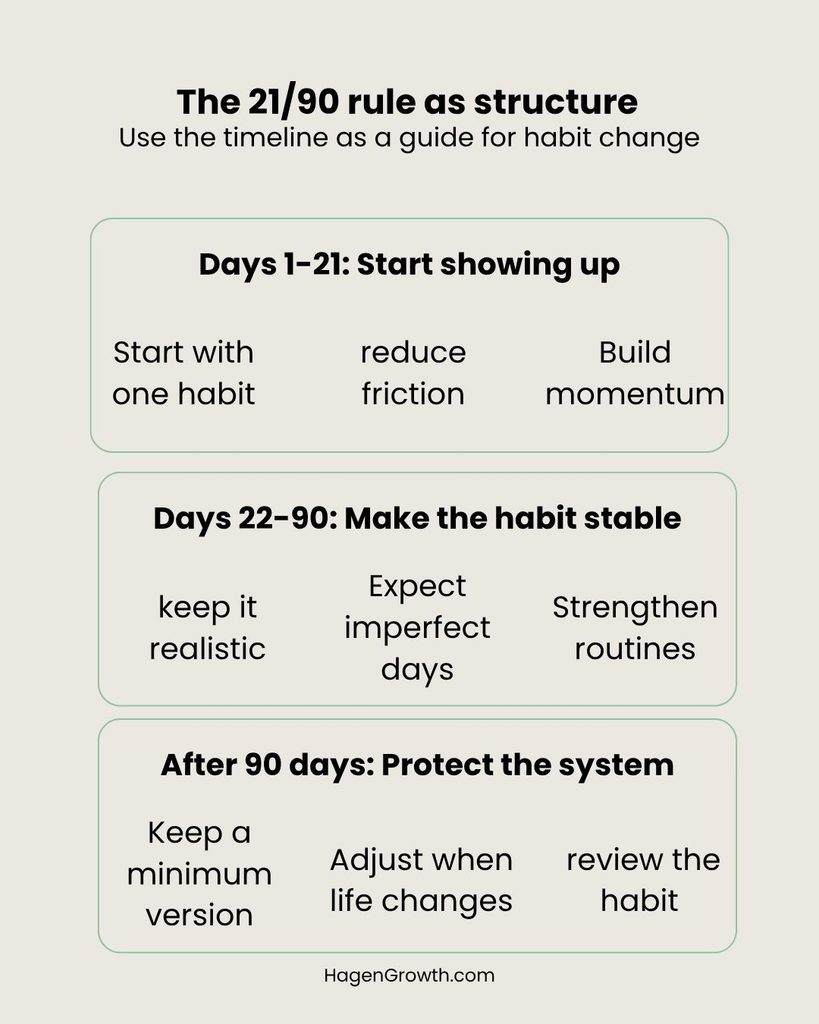
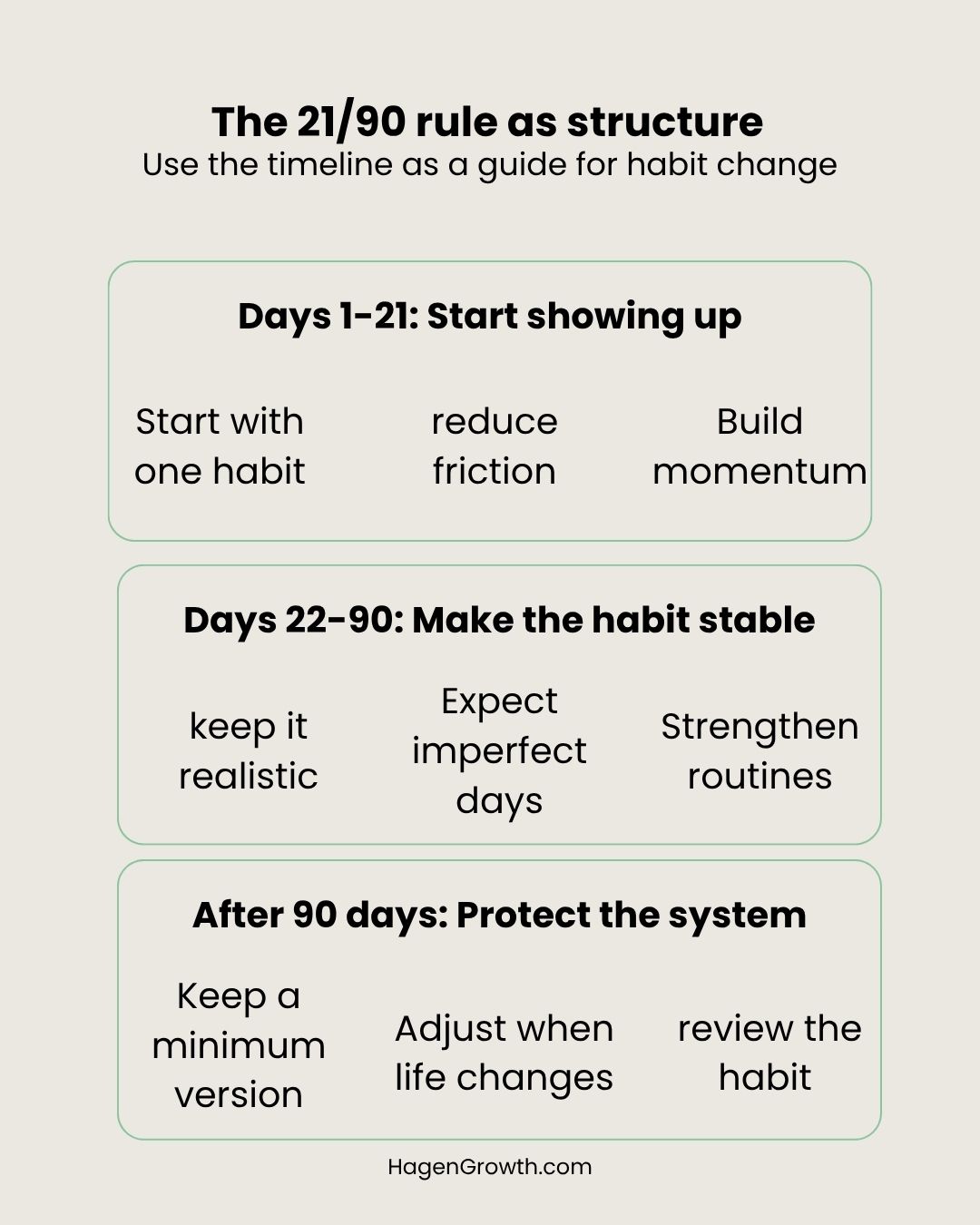
- A better way to use the 21/90 rule is as a structure: 21 days to start, 90 days to stabilize, and after that to maintain the habit.
- The rule works best when you focus on one small habit, build support around it, and return quickly when you miss a day.
What is the 21/90 rule?
The 21/90 rule is a personal growth theory that claims that if you do something for 21 days straight, it becomes a habit, and once you reach 90 days, it becomes a permanent part of your lifestyle.
Because habits shape many areas of life, the rule is often applied to health, work, productivity, fitness, journaling, and other forms of personal growth. That is part of why it has become so popular. It gives people a simple structure for change.
Where did the 21/90 rule come from?
The 21-day idea behind the rule is commonly traced back to Maxwell Maltz’s book Psycho-Cybernetics. Maltz worked as a cosmetic surgeon and noticed that many of his patients seemed to take around 21 days to adjust to changes in their appearance.
Over time, that observation was simplified into the idea that it takes 21 days to form a habit.
The broader 21/90 rule has evolved from there: 21 days to form a habit, and 90 days to turn that habit into a lifestyle change. Whether or not the full modern rule came directly from Maltz, the important point is that the current version is more absolute than the original idea.
The 21/90 rule is useful because it gives change a timeline. It becomes dangerous when we mistake that timeline for a guarantee
Is the 21/90 rule true?
The 21/90 rule is not literally true if you treat it as a fixed law. Habits do not automatically form after exactly 21 days, and a lifestyle does not become permanent just because you reach day 90. So no, the rule should not be treated as a guaranteed timeline. But that does not mean it is useless.
Before we look at how the rule can be used for positive change, we need to look at how realistic the 21/90 rule actually is.
Can you form a habit in 21 days?
The longer you repeat a behavior, the easier it usually becomes. Day 21 will often feel easier than day 1, especially if the habit is small, simple, low-friction, and close to something you already do. But that does not mean the habit is fully formed yet.
In 2009, a study looked at how long it takes to form a new habit. The researchers found that habit formation varied a lot. Some habits became automatic faster, while others took much longer. The habits took an average of 66 days to form, with results ranging from 18 to 254 days.
That means 21 days can be enough to build momentum and make a behavior feel easier. But in most cases, it is not enough to make the behavior fully automatic.
Can you change your lifestyle in 90 days?
90 days is a more realistic timeline for creating meaningful change. It gives you enough time to build routines, reduce friction, and make the behavior feel more normal in your everyday life.
By this point, the behavior may have become a habit, or at least something that feels more stable and natural. So yes, it is possible to create real lifestyle change in 90 days.
But the issue with the second part of the rule is the word permanent.
It doesn’t matter if you do something for 90 days or 900 days. Nothing is fixed forever. Stress, travel, work, grief, relationships, illness, and changes in your environment can all disrupt your habits. And because your habits shape so much of your lifestyle, those disruptions can change how you live.
That might sound discouraging, but it should also make you optimistic. Your good habits are not automatically permanent, but your bad patterns are not permanent either. What matters is not just reaching day 90, but building the kind of support around the habit that helps it survive when life changes.
A better way to understand the 21/90 rule
The 21/90 rule should not be treated as a guarantee. As we saw above, 21 days is not the exact point where a behavior becomes a habit, and reaching day 90 does not mean the change becomes permanent. But instead of dismissing the rule completely, it is better to treat it as a structure.
The first 21 days can be seen as the starting phase. This is where you get used to the new behavior, lower the friction, and build enough momentum to keep going.
The full 90 days can be seen as the stabilization phase. This is where the behavior has more time to become normal, and where it may start to feel like something that belongs in your life.
After 90 days comes maintenance. At this point, the focus is no longer just on building the habit, but on protecting the conditions that keep it alive.
So the 21 and 90-day marks are not magic numbers. They are not promises. But they can give you a useful timeline for staying consistent long enough to start seeing real change.
How to use the 21/90 rule for personal growth
The 21/90 rule becomes more useful when you stop treating it as a fixed promise and start using it as a rough structure for change.
The goal isn’t to force yourself through 21 or 90 perfect days. That is rarely sustainable. Instead, the rule can help you understand what to focus on during different stages of habit formation.
The three phases are:
- The first 21 days are about starting.
- The full 90 days are about stabilizing.
- After 90 days, the focus shifts to maintaining the habit.
Here is how to use each phase.
Days 1–21: focus on showing up
The first 21 days are the starting phase. This is where you begin the new behavior and prove to yourself that it can fit into your real life. At this point, the focus should not be intensity or perfection – consistency is what matters.
Choose one habit, make it small, and make it as easy as possible to repeat. The bigger and more complex you make the habit, the harder it becomes to stay consistent. You can also attach it to a routine you already have, change your environment so the habit requires less effort, and use the 5-minute rule.
For example, if you are trying to build a gym habit, the first phase is mostly about showing up. The exact workout matters less than going when you planned to go. You are not trying to build the perfect training program yet. You are trying to make going to the gym a normal part of your week.
Days 22–90: make the habit stable
After the first 21 days, the behavior will often feel easier than it did at the beginning. You may have some momentum, and the habit may feel more normal. From here, the focus should be on stability.
This doesn’t mean you need to make the habit bigger right away. In many cases, the best thing you can do is keep repeating what is already working. If the base version of the habit is not stable yet, adding more too early can make it harder to maintain. Small wins is what matters here.
This is also where you should expect imperfect days. Missing a day does not ruin the process. What matters is that you return to the habit instead of turning one missed day into a full stop.
With the gym habit, this phase is where training becomes a more coherent part of your routine. You might decide which days you train, prepare your gym bag the night before, or adjust your schedule so the habit is easier to repeat. If the habit feels stable, you can slowly begin to increase intensity, but stability should be the main focus.
After 90 days: protect the system
After 90 days, the habit may feel much more natural. For many people, this is where the behavior starts to feel less like something they are forcing and more like part of how they live. But this is not the finish line.
A habit becomes stronger when it stops depending on perfect conditions and starts fitting into your real life
At this point, the focus shifts from building the habit to protecting the conditions that keep it alive. Your environment, schedule, routines, and recovery plan still matter. If the habit only works when life is ideal, it probably won’t last.
So keep a minimum version of the habit that you can return to when life gets busy. Review the habit occasionally. Notice when your external world changes, and adjust the system before the habit breaks completely.
With the gym habit, this could mean changing your training time when your work schedule changes, finding a new gym before moving, or having a shorter backup workout for busy weeks. The goal is to keep building a life where the habit has a place no matter what’s going on instead of relying on willpower alone.
Common mistakes when using the 21/90 rule
The 21/90 rule is often made simpler than it really is. Because of that, people can easily use it in ways that make habit change harder instead of easier.
Here are some of the most common mistakes to avoid.
Treating 21 or 90 days as the finish line
The first 21 days are about creating momentum, and the full 90 days are about making the habit more stable. But neither of them is the final endpoint.
As we looked at above, habits usually require less effort over time, but they still need some attention and protection if they are going to remain part of your life.
So don’t treat day 21 or day 90 as the finish line. Treat them as milestones. They can help you understand where you are in the process, but the real goal is not just to reach a date, but to build a habit that can continue as a natural part of how you live.
Trying to change too much at once
The rule works best when it is applied to one clear behavior at a time. The more habits you try to build at once, the more effort the process requires, and the more likely you are to fall back on motivation alone.
This is common with health goals. You decide to improve your sleep, diet, training, screen time, and productivity at the same time because they all matter. But when everything changes at once, the process becomes harder to sustain.
A better approach is to choose one meaningful habit, make it stable, and then add the next. Often, the next habit becomes easier because the first one has already changed parts of your routine, identity, or environment.
Counting days instead of building a system
Counting days can be motivating. It gives you something clear to aim for, and it can help you keep going when the habit still feels new. The problem arrives when the countdown becomes the whole strategy.
If your habit depends only on willpower until day 21 or day 90, it will probably struggle when life gets stressful. The behavior needs support around it. Your environment, routines, cues, friction, and recovery plan all affect whether the habit becomes stable. The days can help you stay consistent in periods, but the system is what helps the habit survive.
Thinking one missed day ruins the process
You may feel like missing a day is going to ruin your progress. I know I did. And it’s true that one missed day can become the beginning of the end if you handle it badly.
But the missed day itself is usually not what breaks the habit. The real problem is how you respond to it.
If you respond with shame, frustration, or punishment, the habit starts to feel heavy. It becomes associated with failure instead of growth. That makes it harder to return.
But if you respond with acceptance, curiosity, and a normal return the next day, one missed day does not have to matter much. In many cases, learning how to recover from a missed day is part of what makes the habit stronger over time.
One missed day doesn’t break a habit. What matters is whether you turn it into a full stop or a normal return
Final thoughts
The 21/90 rule claims that if you repeat a behavior for 21 days, it becomes a habit, and if you continue for 90 days, it becomes a permanent part of your lifestyle.
That is too simple. The rule is not a scientific law, and the numbers should not be treated as fixed promises. There are too many variables – the habit itself, your environment, your stress, your routines, and your current identity – to create one universal timeline for change. But that does not make the rule useless.
The better way to use the 21/90 rule is as a structure. Use the first 21 days to start showing up. Use the full 90 days to make the habit more stable. And after that, protect the system that makes the habit possible.
That is how the 21/90 rule can actually help you build habits and create real personal growth.
Further reading
How long does it take to form a habit?

- Mindset and Discipline: The Foundation of Sustainable Change - March 4, 2026
- Thinking Vs. Reflection – What is the difference? - February 20, 2026
- Why we do things we later regret – and how to interrupt the pattern - February 13, 2026