
There are only a few things more satisfying than a productive day. A day where you finished everything you had to and can relax in the evening with a clear conscience. For most people, this feeling is rare. They lack the necessary knowledge and tools to stay productive consistently. One way to gain both is with a productivity journal.
In this article, we’ll explore what a productivity journal is, the different types, and how you can use one to increase productivity.

What is a productivity journal?
As the name suggests, a productivity journal is a type of journaling you can use to increase productivity. It can do so by helping you plan ahead, learn more about yourself, and create accountability. It can help you discover the changes you need to make to your workflow or lifestyle to increase your output.
Related: Increase productivity with the 2-minute rule
What are the benefits to journaling for productivity?
The obvious benefit is increased productivity, a larger output, and more effective use of your time. But it isn’t the only one. The following is a list of some of the possible benefits you’ll see from productivity journaling:
The obvious benefit of a productivity journal is an increase in productivity. But this isn’t the only thing you’ll gain. Below are 5 other benefits you may gain from your productivity journal.
1. Less procrastination
As you increase your ability to get things done in one area of your life, you’ll notice that it gets easier all around. This can decrease procrastination.
Related: How one habit can change your life
2. Reduce stress
Leaving things unfinished is a major stressor. When you increase productivity, you’ll most likely have fewer unfinished tasks and a shorter to-do list. With this, your stress levels might decrease.
Related: journaling for stress and anxiety
3. Better mood and self-confidence
Your productivity journal gives you a better approach to working on your goals and a clear way of noticing progress. This will increase your self-confidence and can improve your overall mood.
Related: How to improve self-esteem
4. Increased chances of reaching your goals
An increase in productivity doesn’t ensure that you’ll reach your goals, but it’ll increase the likelihood. The more you work towards it in a structured manner, the more likely you’ll get there.
5. A chance to gather small wins
You gain small wins every time you overcome something difficult or do something good for yourself, which by itself has numerous benefits. Your productivity journal can help you accumulate and celebrate these.
Types of journals for productivity
There are different journaling techniques intended to increase productivity. All are worth trying, but some will work better depending on your personality and goals. Below are 4 different types and how to use them.
Related: How to boost productivity using the 5-second rule
1. Today and tomorrow (Reflect and plan)
The Today and Tomorrow journal helps increase productivity by creating accountability. You do this by reflecting on your productivity at the end of the day and preparing yourself for tomorrow. Here’s how it works.
- Get your journal out at the end of your day. This can be in a notebook, a phone, a laptop, or somewhere else where you can write.
- Start by writing today’s date. Under it you’ll write when you worked, and a short note about your day. You can include anything that might influence your productivity, such as mood, external factors, bad decisions, and more. Remember to be critical and honest with yourself here.
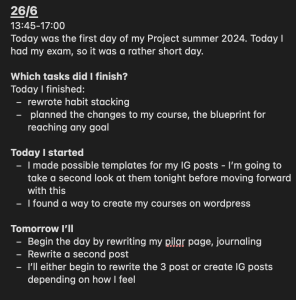
- Make a section called “Which tasks did I finish?” Here, you’ll go through the tasks you planned to do and actually did.
- Make a section called “Today I started.” Here, you’ll focus on all the work you managed to start besides those you had planned.
- Make a section called “Tomorrow I’ll.” In this section, you’ll plan ahead and decide which tasks you’ll do tomorrow.
- If you notice that something can improve, you can write a short note about what it is and how to improve it here.
- Repeat.
By following the 7 steps above, you’ll create accountability and get a better structure. Both are things that can improve your productivity. Below is an example of one of my entries in my today and tomorrow productivity journal.
2. Self-evaluation and optimization
The self-evaluation and optimization journal are focused on the bigger picture. With this journal, the objective isn’t to do certain tasks or meet milestones but to increase your future potential.
In this productivity journal, you reflect on when and how you are truly productive, your lifestyle, and other relevant factors. To ensure you ask yourself the right questions, you can use these 8 prompts for this type of journaling.
- How do you define being productive?
- What circumstances increases your productivity?
- What decreases my productivity?
- What time of the day are you the most productive?
- What time are you the least productive?
- Are you eating well? Should you decrease or increase anything?
- Are you getting enough quality sleep?
- Are you stressed? If yes, what’s causing it?
Once you’ve answered these questions, you can finish by summarizing your points. What should you do, what can you do better, and what should you avoid? Use it to optimize and create the perfect conditions for you to be productive.
Unlike the today and tomorrow journal, you don’t have to write in this type every day. Once a week, or even once a month, will be enough to see progress if you take it seriously and apply the newfound knowledge.
3. Stream of consciousness journal for productivity
A stream of consciousness journal is a journaling technique where you follow your thoughts and write down exactly what you’re thinking about. It’s free of structure, and you usually don’t have to think about anything but writing down your exact thoughts. It’s typically used for self-discovery and to release stress and anxiety, but can also help you increase productivity.
To do this, all you have to do is begin by thinking about your productivity. What does it mean to you, how is it, what works for you, and what doesn’t? Focus on these things and begin writing down your exact thoughts. Follow them, and don’t feel like there is any right or wrong here. Anything that crosses your mind is relevant enough to be included.
4. Goal journal
A goal journal is a type of journal that helps you determine what your goals are and what you have to do to reach them. When done right, it’ll help you understand what you want to achieve and what you need to do to get there.
How to journal for productivity
At this point, you’ll have a good understanding of what productivity journaling is and the different techniques. Here are 6 tips to help you get started and get the most out of your productivity journal.
Related: 39 journal prompts to boost productivity
1. Pick the right type(s)
Depending on who you are and where you are in life, you’ll benefit from different types of productivity journaling. Below, we’ll briefly explore when the different techniques work best.
The today and tomorrow journal
This journal works best when you know what you should be working on and how you work best but still struggle to get things done.
The self-evaluation and optimization journal
This type of journal works best when you’re unsure of what you need to increase your productivity. It can be used when you have something specific to work on and when you don’t.
The stream of consciousness journal
The stream of consciousness journal are similar to the self-evaluation and optimization journal and works best under the same circumstances.
The goal journal
The goal journal is great for when you’re unsure about what you want to achieve or how to get there.
Sometimes, you’ll find that you only need one of the journals, but often, it’ll be a combination of more. Give the different techniques a try and see which one works best for you.
Related: How to use journaling for problem solving
2. Make productivity journaling a habit
It maybe be easy to journal when you feel motivated, but you won’t always feel like this. Making productivity journaling a habit can make it easier to stick with it on difficult days.
There are several ways you can do this. Try to pick a specific time each day when you’ll write, make it a part of your routines, or use one of the other techniques mentioned here.
3. Aim for good enough, not perfect
Your productivity journal doesn’t have to be perfect. It just has to be good enough. Don’t waste your time worrying about spelling or grammatical mistakes, how your writing looks, or phrasing.
Trying to make it perfect might give you a sense of satisfaction, but it can easily remove focus from the main point. Increasing productivity. It might even make consistency more difficult.
Remember, nobody but you have to see it. So why would it matter if it contains spelling mistakes or wrong formatting?
Related: How to increase productivity with just 5 minutes
4. Analyze yourself and your performance
No matter what, you’ll face periods where you’ll struggle with productivity. These periods might be discouraging, but they can help you understand yourself better and prepare you for the next time you face these difficulties if you regularly analyze yourself and your performance.
5. Use it as or with your to-do list
Most of us have a to-do list but sometimes struggle to finish it. This can cause frustration and might even impact our general productivity.
By pairing it with a productivity journal, such as the today and tomorrow journal, it’ll be easier to finish it. It might even improve our overall productivity.
Related: How to keep your to-do list short
6. Be patient
Increasing productivity is a gradual process. Slowly as you practice and use the journal, you’ll get better, but it won’t necessarily be fast.
Your daily average output might not increase much day to day. But when it accumulates over weeks and months, it’ll be significant. Be patient and stay consistent. Soon, the results will follow.
Final thoughts
A productivity journal is one of the few tools that can give you more time in your day. Not because you get more hours, but because you’ll be better at using them.
You might not get the results you want from day one, but with patience and consistency, you will.
What to read about next

- Mindset and Discipline: The Foundation of Sustainable Change - March 4, 2026
- Thinking Vs. Reflection – What is the difference? - February 20, 2026
- Why we do things we later regret – and how to interrupt the pattern - February 13, 2026