
Sleep is one of the most important things for a human to function. We need it to recover from the day’s stresses, to use our cognitive abilities, and to grow. Despite this, many find it hard to get enough quality sleep. They might struggle to fall asleep or wake up throughout the night. One way to solve this is to form habits that promote better sleep.
In this article we’ll explore 9 habits that can help you sleep better.
Related: What are habits?
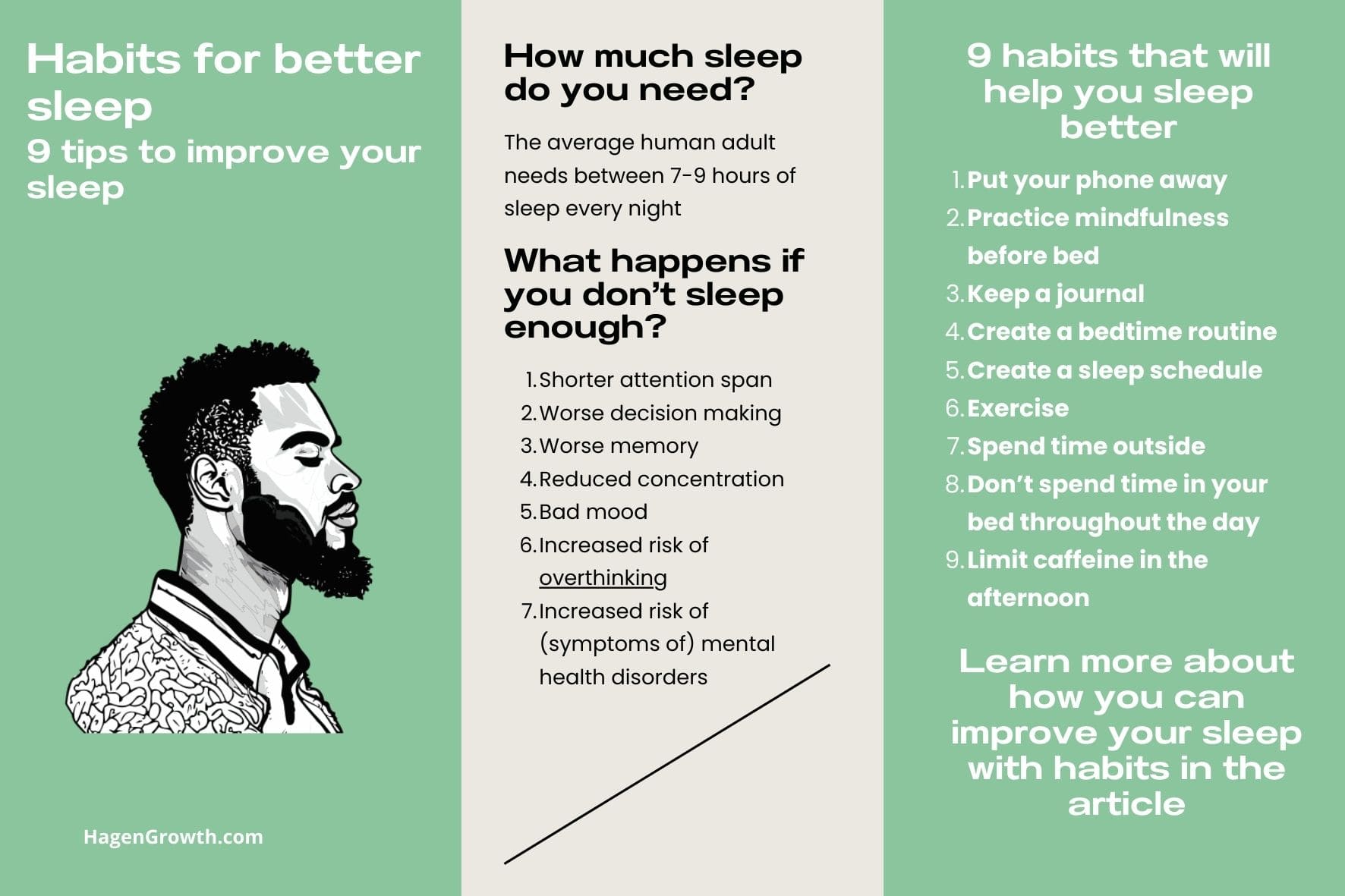
Why a good night of sleep is important
Sleep is the most important thing you can do for physical and mental recovery. It’s when you sleep you recharge and get ready for a new day. Some common symptoms of only getting 6 hours of sleep are:
- Shorter attention span
- Worse decision making
- Worse memory
- Reduced concentration
- Bad mood
- Increased risk of overthinking
- Increased risk of (symptoms of) mental health disorders
And that’s just from missing a couple of hours of sleep. Imagine what getting 4 hours a night will do.
How much sleep do you need?
How much sleep we need to function optimally varies from person to person. Age, diet, activity levels, stress, and genes influence this. However, 7-9 hours of sleep a night is adequate for the average person.
What is bad sleep quality?
Bad sleep quality is everything that disturbs your sleep. Two common issues with sleep quality are trouble falling asleep and staying asleep.
You might experience bad sleep quality for several reasons. Stress, anxiety, bad habits, and past trauma are all common reasons why you have sleep issues. But no matter the cause, the habits in this article can improve your sleep.
9 habits for better sleep
Our habits at night and throughout the day have a massive impact on our sleep. Depending on your habits, they can help you sleep well and keep you up at night. Below, we’ll explore 9 habits for better sleep.
1. Put your phone away
For many, their phone is the first thing they look for when feeling bored. Overuse of phones and social media can shorten your attention span, worsen your memory, and decrease motivation. And when used in the evening, it can affect your sleep. It can cause symptoms of stress and anxiety. It can provoke a mild emergency response in the body, which will make it difficult to relax, and the quality of your sleep worsens.
The blue light on your phone tricks your brain into thinking it’s daytime, and it’ll stop releasing the sleep hormone melatonin. Melatonin is what helps you calm down and get ready for bed. The blue light on your phone can stop this process, and it’s difficult to fall- and stay asleep.
Try to create the habit of putting your phone away in the evening. The optimal is two hours before bedtime, but less can also be beneficial.
2. Practice mindfulness before bed
When you practice mindfulness, you practice being in the present. You stop reacting to every single thought, and you’ll feel calmer. Creating the habit of practicing mindfulness can help you feel happier, more relaxed, and sleep better.
Meditation, breathwork, and gentle yoga are some of the best habits in the evening to practice mindfulness and get better sleep. All three activities have slightly different benefits, but all can be helpful. Try them, and see what works for you.
3. Keep a journal
Journaling is a great tool to calm your mind and stop overthinking. This makes it a great habit to do before you go to bed. There are several kinds of journaling. Two of the best to do in the evening for good sleep are:
Stream of consciousness journal
A stream of consciousness journal is a journal where you write down whatever is on your mind. It’s so simple, that it can be confusing.
All you have to do is to write whatever comes to your mind and just keep writing until your head feels empty or you don’t want to write anymore. Don’t think about grammar or structure. That doesn’t matter here. Follow the train of thought and see where it takes you.
When you’re done, your mind will be calmer, and your sleep improves. You can do this on nights when you can’t calm down, but you can use it every night.
Gratitude Journal
The feeling of not having (done) enough can cause many restless nights. You might feel that you haven’t studied enough for the exam, need more money, or won’t get enough sleep since you have to get up early. When you feel like you don’t have enough, your body will activate the emergency response to ensure you can go out and get it.
With a gratitude journal, you’ll focus on the things you have. Maybe you’re grateful for your family, friends, a pet, an achievement, or a kind stranger. Something as simple as a bed, a roof over your head, and food in the fridge are worth feeling grateful for. When you feel gratitude for what you have, your body will calm down, and you can sleep better.
4. Create a bedtime routine
If you follow the same schedule most days, you might have noticed that your body has adapted to your routines. You get hungry around the time you usually eat, feel energized when you should be at work, and wake up when your alarm usually goes off. If you begin to scroll every time you hit the bed, you won’t be tired, and you’ll find that sleeping is difficult. On the other hand, if you create a good bedtime routine, sleep will become easier.
The routine can be something small as brushing your teeth, flushing, setting your alarm, and then going to bed. It can also be something that takes hours, starting with dinner or anything in between.
The important thing isn’t how many habits you have stuffed into your nighttime routine but that you have a ritual to let yourself know that it’s time to sleep.
5. Create a sleep schedule
Similar to the above, creating a sleep schedule can help you sleep better. A sleep schedule simply means that you go to bed and get up at the same time every day.
To do this you need to keep two things in mind.
- You should be able to get 7-9 hours of sleep
- You should be able to maintain the schedule 9 out of 10 days.
Try to experiment with going to bed and waking up at different times. Once you’ve found something that works for you, stick with it. If you follow your sleep schedule every day, even on weekends, you’ll quickly notice how your sleep improves.
6. Exercise
Most mental and physical problems can be improved with an exercise routine, and sleep is no different. While exercise has many benefits that can aid sleep, one of them is the regulation of hormones.
Exercise can reduce levels of stress hormones, such as cortisol and adrenaline. When the body releases less of these hormones, symptoms of stress and anxiety will decrease, and it will be easier for the body to relax. It also increases the production of endorphins, the body’s natural painkillers. This hormone makes you feel less pain, decreases stress, and improves mood.
Many see exercising as something unpleasant, but the changes it can bring to your life are worth it.
Related: Keystone habits
7. Spend time outside
When you spend your days inside with artificial light, you can throw your internal rhythms off. If your internal rhythm is off, your body doesn’t know when it’s time to rest, and your sleep quality will suffer. When you’re exposed to sunlight, the body’s rhythm “resets,” and it will be easier to fall asleep at night.
8. Don’t spend time in your bed throughout the day
Some people spend the majority of their time in their beds. They watch TV, spend time on their phone, do homework/work, and many other things. And sure, the bed might be the most comfortable piece of furniture in your home. But while it seems harmless to live in your bed, it can hurt your sleep.
When you spend too much time in bed, you get used to something happening while you’re there. That you’ll get some reward. The anticipation makes it difficult to shut down for the night, and you’ll often find yourself unable to sleep. Instead, you end up on your phone or with Netflix until you fall asleep.
Break the habit of spending time in bed unless you’re going to sleep. Over time, you can teach yourself that the bed is for sleeping, and the quality of your sleep will improve.
9. Limit caffeine in the afternoon
Caffeine is a stimulant that increases attention and alertness. During the day, it can help you be more productive and feel more awake. But if it’s effects haven’t worn off at night, it can make it harder to fall and stay asleep.
It takes around 8 hours from getting caffeine until the effects have fully worn off. If you want to avoid that it interferes with your sleep, don’t drink caffeine at least 8 hours before bed.
Related: Discover your bad habits
Sum up
Not getting enough quality sleep is a serious problem for many. It decreases cognitive abilities, increases the risk for mental health disorders, and decreases physical performance. Try the 9 habits mentioned in this article and see your sleep improve.
What to read about next

- Mindset and Discipline: The Foundation of Sustainable Change - March 4, 2026
- Thinking Vs. Reflection – What is the difference? - February 20, 2026
- Why we do things we later regret – and how to interrupt the pattern - February 13, 2026