
Most people experience the stresses of life every day. We all occasionally feel difficult emotions and let intrusive thoughts into our heads. Most of us want to be healthier and improve our cognitive abilities. The simple habit of daily meditation can give you all of that.
Let’s have a look at what meditation is, how to do it, and how to make meditation a daily habit.
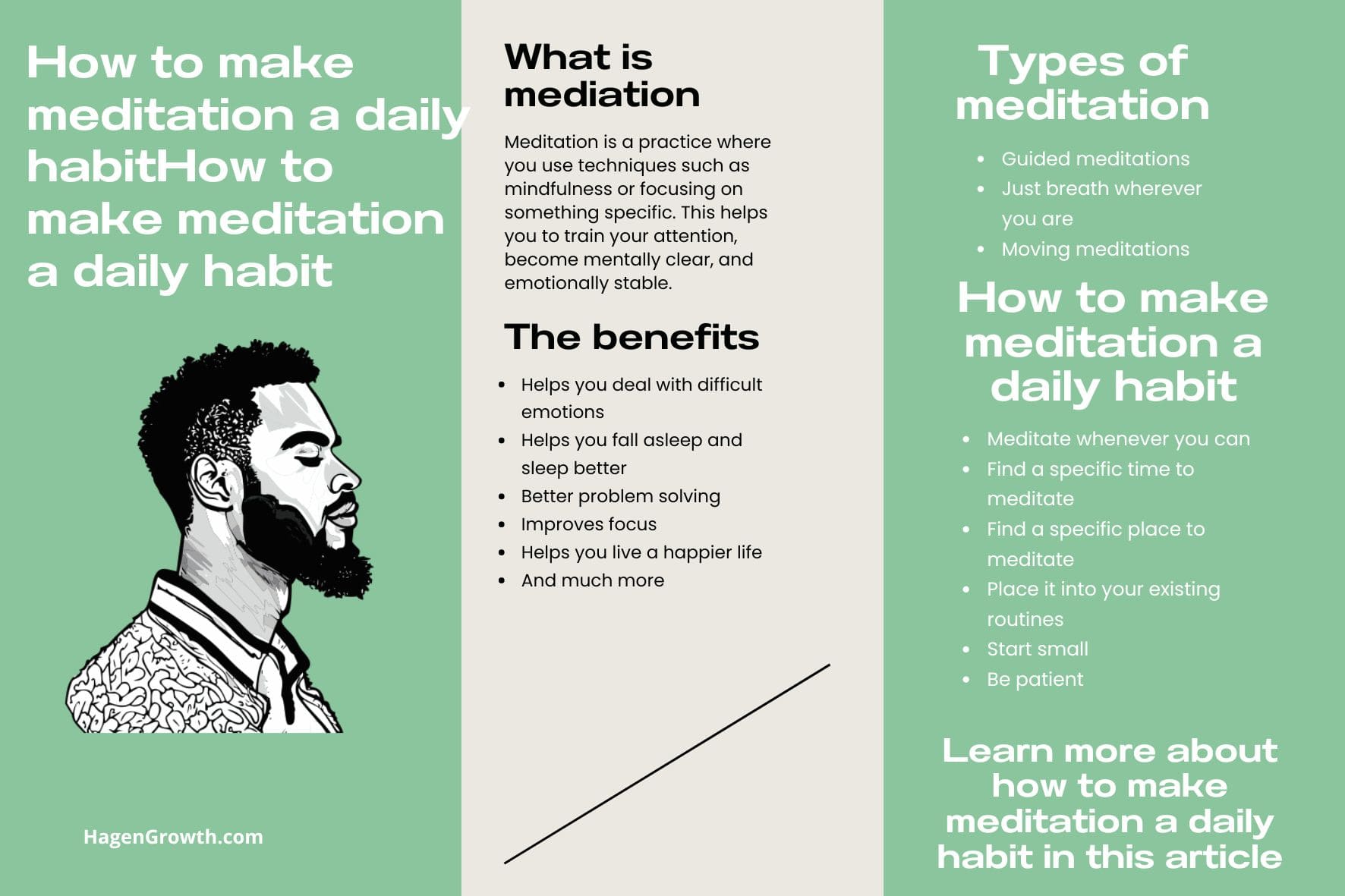
What is meditation
Meditation is a practice where you use techniques such as mindfulness or focusing on something specific. This helps you to train your attention, become mentally clear, and emotionally stable.
Meditation is a practice that helps you create a moment of peace. It allows you to step away from thoughts and anything that might take your attention.
There are many forms of meditation, and all can be useful depending on your goals and current mental state. A few of them are:
- Mindfulness meditation
- Focused meditation
- Moving meditation
- Loving-kindness meditation
- And much more
Related: The best habits for self-improvement
The benefits of daily meditation
There are many benefits to daily meditation, both short- and long-term. Let’s have a look at those.
1 Short-term benefits of daily meditation
Meditation is a great tool for dealing with difficult feelings and stress. Just one short meditation can help you relax, process your emotions, calm down overthinking, fall asleep, and much more.
A study even showed that just a few minutes of meditation can make you physically healthier.
Related: How to use a journal for mental clarity
2 Long-term benefits of daily meditation
Studies have shown that daily meditation can rewire the brain over time. When you regularly practice, you can improve emotional regulation, problem-solving, focus, resilience, self-awareness and more. Over time, it can even make your reflections more effective.
Over time, you’ll notice that you sleep better, stress less, handle crises better, become more compassionate, and happier. Studies have shown that 30 days of meditation can improve your life satisfaction.
How long to meditate daily
It doesn’t require much time daily to see the benefits described above. Just a few minutes before going to sleep or waiting for the bus will get you far.
However, the longer your meditation is, the longer you give yourself to get into a calm and relaxed state and gain the full potential of the benefits.
How to meditate
Now that we understand what meditation is, we can begin to look at how to do it. I prefer to use one of the following 3 methods depending on my mood and where I am.
1 Use guided meditations
Guided meditations are a type of meditation where someone helps you use various physical and mental techniques. They’re often tailored to specific needs, which makes them highly effective for your needs.
You can find various guided meditations on YouTube and Spotify. You can find our guided meditations here.
2 Sit or lie down and breath
If we leave our phones and other distractions behind, we’re presented with countless opportunities to meditate every day. With this approach, you can take advantage of that. Give this a try next time you’re bored instead of picking up your phone. Here’s how you do it.
- Find a time were you’re sitting or lying down. This might be before going to sleep, waiting for the bus, or on the toilet.
- Slowly bring your attention to your breath. Feel the air going in and out of your nostrils.
- Keep your attention here for a while.
- If your mind starts to wander, slowly bring it back to your breath.
- Now you can decide to continue your meditation, and feel a deeper sense of calm, or slowly get back to the present and continue with your day.
Related: Small habits that’ll change your life
3 Use moving meditations
Most people view meditation as something where you have to be still for it to be effective. But it doesn’t have to be. Moving meditations are just as effective as other kinds and, for some people, easier to get into. My favorite moving meditations are:
Related: How to make exercising a habit
Walking meditations
Most people walk every day. This presents an opportunity for daily meditation. Here’s how you do it.
Next time you’re walking, try to bring your attention to your body. Feel how your arms swing by your side. After a while, you can move your focus towards your legs. How the muscles engage for every step, and how your feet connect with the ground. After a while, you can try to keep your attention on your whole body as you move.
You might find that your attention starts to wander. That’s okay. Slowly bring it back to your body and continue this practice for as long as you’d like.
Mindful yoga
Slow and mindful yoga practices, such as Yin Yoga, are a kind of mediation.
If you struggle with the other approaches, you might find this easier. The slow movements and the discomfort from your stretched body give you something immediate and noticeable to focus on. This, paired with the relaxing effects of stretching, makes it a great practice.
How to make meditation a daily habit
There are many kinds of meditation. Picking the right option for you will make it easier to make meditation a daily habit. However, you’ll often find that you need more than that.
Below are 6 things you can do to make meditation a daily habit.
1 Meditate whenever you can
Sometimes, it can feel difficult to find the time for meditation. But you don’t have to consciously take time to do this.
As we discovered above, you’re presented with endless possibilities for meditating every day. Leave your phone behind and take advantage of these to make meditation a daily habit.
2 Find a specific time to meditate
This advice might be contradictory to the first, but that doesn’t make it any less valid.
Having a specific time of the day when you meditate will make it easier to make it a daily habit. It can be when you wake up, before bed, or any other time of the day.
Doing this, you’ll train your body to crave the meditation when the time comes. Instead of having to force yourself to meditate, it’ll become easier.
3 Find a specific place to meditate
Designating specific places to do specific things makes it easier to form a habit. When you know that the chair or that spot is for meditating, you’ll feel less resistance when it’s time to practice. You might even crave it whenever you get to that spot.
4 Place it into your existing routines
Habit stacking is an effective habit-building technique that utilizes your existing routines to build new habits.
For a habit to be formed, it has to go through something called the habit loop. The stages of the habit loop are called cue, routine, and reward. Often, it’ll be hard to find a good cue for a new behavior. When you stack your habits, the reward from the original habit will act as a cue for the new behavior. It can be done at any time of the day and will still be effective.
All you have to do is find one existing habit and then begin to meditate straight after. For a while, it’ll require some conscious effort. But soon, it’ll become as automatic as brushing your teeth at night.
Related: How to find the right habit for habit stacking
5 Start small
The more time and effort a behavior requires, the more resistance you’ll feel by doing it. This makes it more difficult to form a new habit.
To make meditation a daily habit, you can start small, especially if you find it difficult at first. Start with 1 minute every day. As this becomes a habit, you can slowly increase the time until you are at a point where you feel satisfied.
Remember, consistency is all that matters when forming a daily habit. Doing 20 minutes is good, but if you can sustain it, what good will it do?
Related: How small wins can lead to big achievements
6 Be patient
Not everyone finds meditation easy or even enjoyable the first time they do it. Give it time. Be patient with yourself, let yourself ease into it, and accept that you might miss a day here and there.
If you can stay patient and consistent, it’s only a matter of time until meditation becomes a daily habit.
Take away
Daily meditation is one of the best habits you can form for your physical and mental health. I hope the techniques and tips in this article can help you begin and find the peace you deserve.
What to read about next

- Mindset and Discipline: The Foundation of Sustainable Change - March 4, 2026
- Thinking Vs. Reflection – What is the difference? - February 20, 2026
- Why we do things we later regret – and how to interrupt the pattern - February 13, 2026