
Most of us want to be as efficient as possible. This has led us to develop several strategies to increase our productivity. Some of these are effective and are profoundly helpful. Others might seem positive, but in reality, hurts our output. One of these seemingly positive strategies is multitasking.
In this article, we’ll explore what multitasking is, why it’s bad for productivity, and how you can beat the habit of multitasking.
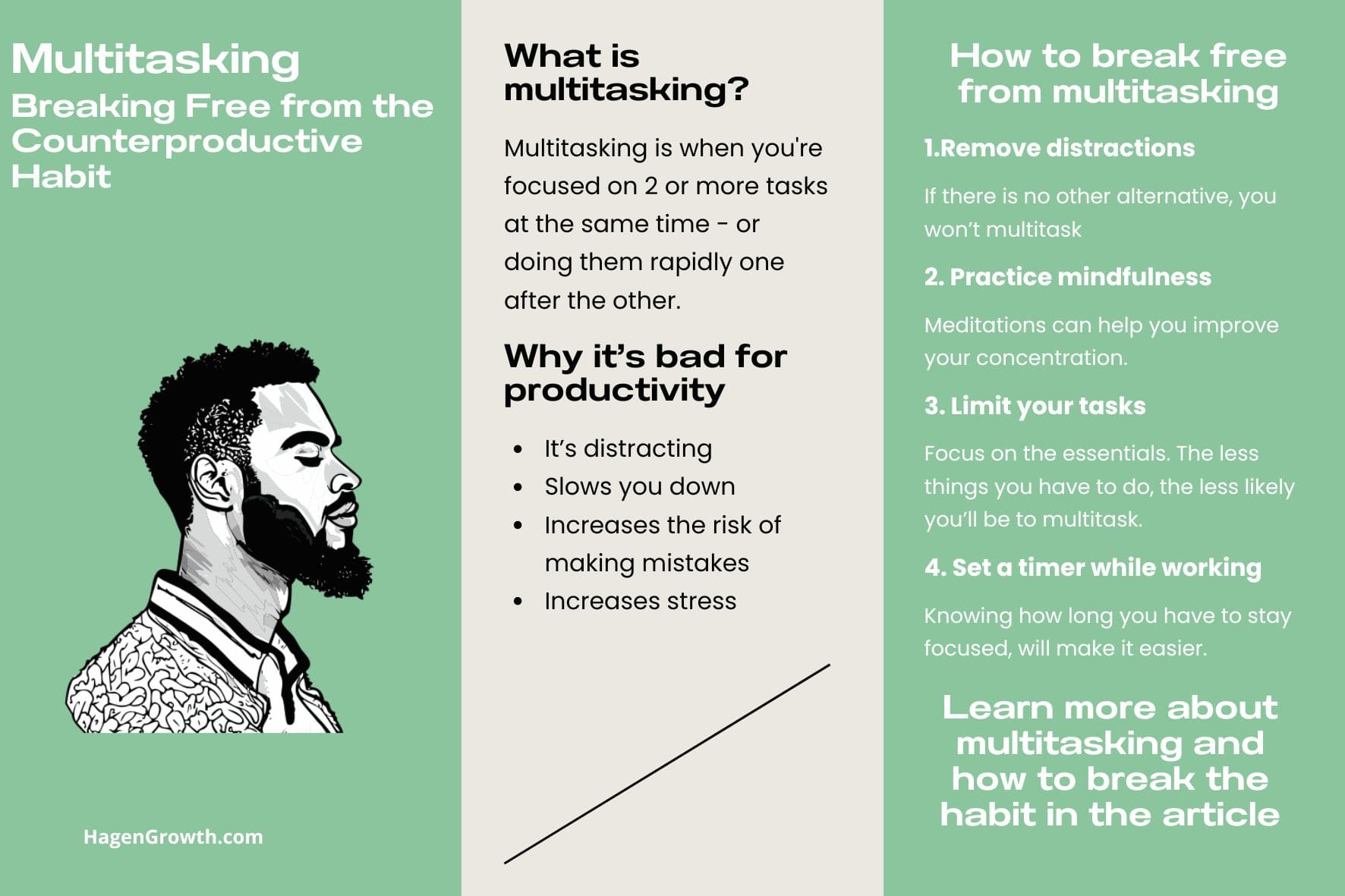
What is multitasking
Multitasking is when you’re focused on 2 or more tasks at the same time – or doing them rapidly one after the other. While this might seem like the perfect strategy for boosting productivity, it can actually hurt your output.
Your brain can’t focus on more than one task at a time. Instead of being focused on two tasks, your brain is quickly switching from one to another when you’re multitasking. This means it’ll be harder to get into a flow state, your output will be worse, and you’ll feel drained at the end of the day.
In some situations, it’ll be impossible to avoid multitasking. However, when possible, focusing on one task at a time is the best way to ensure quality and effort match your output.
Related: How to boost productivity with a journal
Examples of multitasking
Let’s look at a few examples of multitasking.
- Talking in the phone while writing
- Starting more than one project at once
- Scrolling through social media between sets at the gym
- Watching TV while working
- Listening to someone talk while being on your phone
And the list could go on. Anything you do where your attention is required several places at once is multitasking.
What happens in your brain while multitasking
When you begin a certain task, your brain goes through 2 stages.
- Goal shifting: You decide to do something and expect a certain outcome
- Rule activation: Your brain changes the rules to match those of the task you’re about to start
Your brain subconsciously goes through these stages before starting any task. When you’re multitasking, your brain goes through the same stages. But instead of doing it once at the beginning, it does so every time you switch between tasks. Let’s have a look at how this affects productivity and the quality of your output.
Related: The worst habits for your mental health
Why multitasking is bad for productivity
Now that we have an understanding of what multitasking is, we can find out why it’s bad for productivity. In the following section, we’ll explore 4 different ways multitasking can affect your productivity.
1. Multitasking is distracting
Multitaskers tend to feel more distracted. This is unsurprising when you think about what happens during multitasking. You might feel this by being more distracted while you’re working. But the consequences might be more severe than that.
When you multitask, you train your brain to quickly switch from one task to another. Over time, this can make it harder to focus and make you more easily distracted.
2. Multitasking slows you down
While it might seem that multitasking should make you work faster, it tends to have the opposite effect. Actually, it makes you slower and less efficient. It takes time for your brain to switch from one task to another. The more you do this during a task, the longer it’ll take to finish.
When you’re concentrated long enough, you might enter a state called flow. During flow state, you’ll produce your most efficient and best work. While it might be difficult to reach this normally, you make it impossible if you constantly switch your focus from one thing to another.
3. Multitasking increases the risk of making mistakes
Multitasking makes you more likely to make mistakes. You’re more distracted and aren’t fully focused on the task at hand. People who multitask are not only more prone to mistakes, but their performance tends to be lower.
4. Multitasking is stressful
The best way to produce good work consistently is to have a relaxed mind. It’s when you can relax and think clearly. Multitasking can make this difficult.
It’s taxing for your brain to constantly switch between tasks as your brain needs energy to change rules and goals. The more you do this, the more likely you are to get stressed, even from smaller, seemingly simple tasks.
How multitasking affects your brain long term
Doing several things at once has several short-term consequences, as mentioned above. But when done consistently, the consequences gets more serious. Chronic multitaskers might experience the following:
- Problems with setting goals and sticking with them
- Worse concentration and are easily distracted
- Problems with avoiding irrelevant distractions
- Worse impulse control
- Tends to downplay the risks of doing multiple things at once
And these are just some of the possible consequences. Some people might be affected more than others by these. But everyone can be at risk.
Related: How to improve your attention span with mediation
How to break the habit of multitasking
Now that you understand multitasking and how it affects your productivity, it’s time to see how you can break the habit. Let’s have a look at 4 techniques you can use here.
Related: How to boost productivity with the 5-minute rule
1. Eliminate distractions
A common reason for multitasking is that you have a more gratifying alternative. Your phone gives a bigger mental reward than reading a book.
You can use this to make the primary thing you want to do the most rewarding option. The solution here is to eliminate your distractions. Leave your phone in another room, put your PlayStation in a closet, or turn off the WiFi. Once the distractions are gone, it’ll be easier to focus on just one thing.
2. Practice mindfulness
Mindfulness is the practice of being present with whatever is. Practicing this has two benefits that can help you break your multitasking habit.
- It helps you to be aware of when you’re multitasking
- It improves your concentration which makes it easier to stay clear of distractions.
Practicing mindfulness might not stop you from multitasking straight away. But with practice, it’ll be easier to stay focused and the habit will soon begin to change.
3. Limit the things you need to do
The more things you have to do, the more stressed you are bound to be. The more stressed you become, the more likely you are to multitask. A simple solution to this is to be more selective before adding tasks to your to-do list.
Most to-do lists consist of a few essential tasks but several that aren’t as important. Try to go through your to-do list. Which tasks do you have to do, and which do you feel like you have to do? Are they all equally important? Be honest with yourself and prioritize your time well.
Alternatively, you can create two different to-do lists. One for your essentials and one for the less urgent. Doing this can make things seem more manageable, and it’ll be easier to use your time efficiently.
4. Set a timer for your tasks
It can be difficult to start a task and stay focused without knowing how long to continue. You can make this easier by using a timer next time you have to work. How long you have to work is up to you. However, several people have found different intervals, such as the Pomodoro technique, effective.
For this technique to be truly effective, you have to follow 2 rules.
- Take a break of at least a couple minutes when the timer rings. Make sure that it’s a real break without screens or work. After that, you can decide how to add another interval or leave work for the day.
- Only focus on the thing you planned to do until the timer rings
Both of these might be difficult at first. But as you practice it’ll become easier and this technique more effective.
Final thoughts
Multitasking seems like the perfect technique to optimize productivity. However, it isn’t. It makes your work slower, and the quality will likely be lower.
I hope this article has helped you understand multitasking and how it affects productivity. Finally, I hope you have gotten the right tools to break the habit and boost your productivity.
What to read about next

- Mindset and Discipline: The Foundation of Sustainable Change - March 4, 2026
- Thinking Vs. Reflection – What is the difference? - February 20, 2026
- Why we do things we later regret – and how to interrupt the pattern - February 13, 2026