
We’re faced with many small tasks every day. There’s a message you need to answer, the dishes that should be put away, and the clothes on your bedroom floor. While these tasks are small and quick to finish, how you handle them will influence your productivity and the risk of procrastination. The 2-minute was created as a guideline to help you make the right decisions here.
In this article, we’ll explore what the 2-minute rule is, how to use it, and alternative uses.
What is the 2-minute rule?
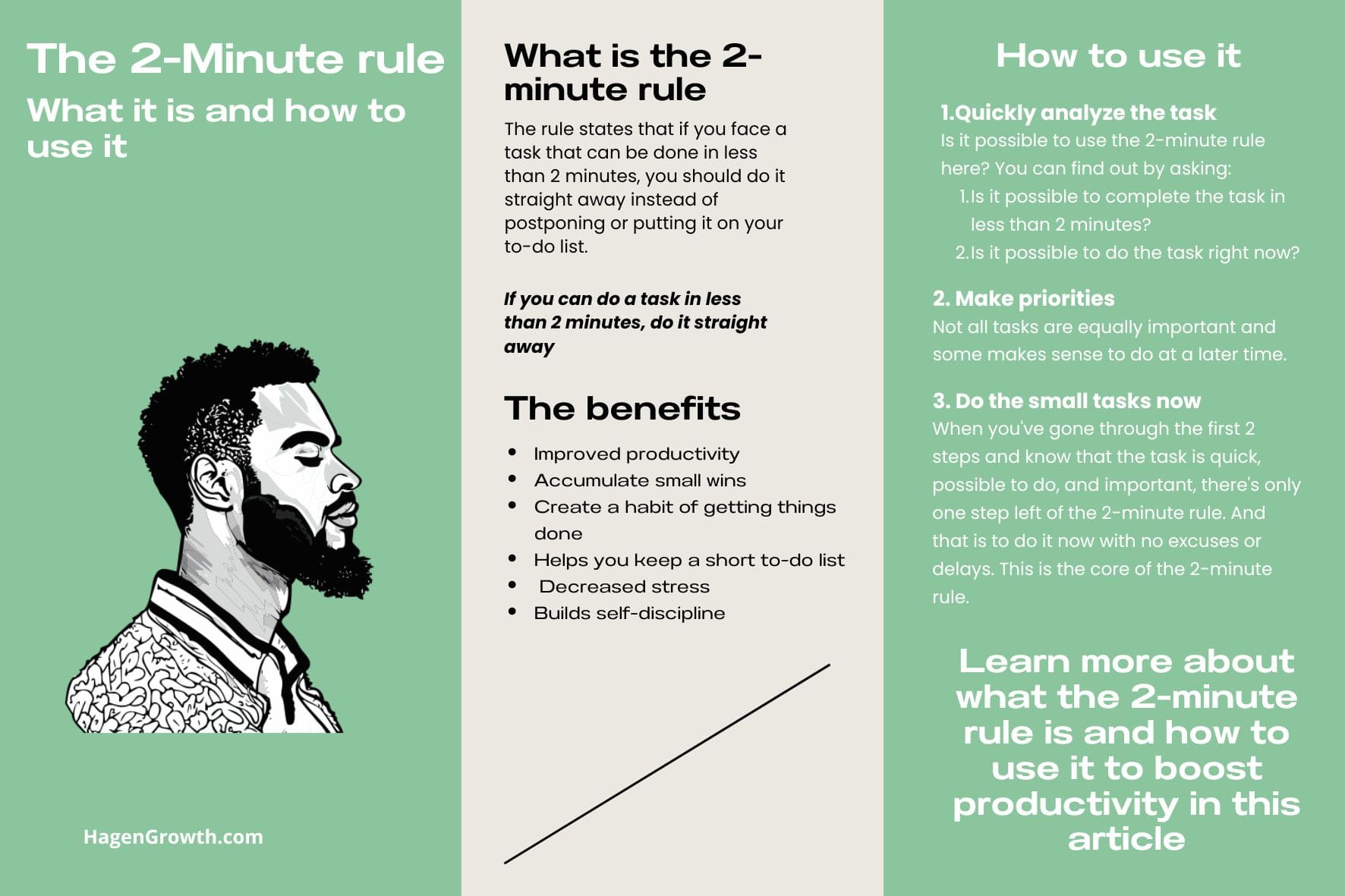
The 2-minute rule was created by David Allen in his productivity book Getting Things Done. The rule states that if you face a task that can be done in less than 2 minutes, you should do it straight away instead of postponing or putting it on your to-do list.
When small tasks accumulate, they can become a distraction and make it harder to do meaningful work. When you immediately deal with them, it’ll improve your focus and productivity and decrease procrastination.
By immediately dealing with the small tasks, you’ll keep a clean mind and a to-do list. With this, it’ll be easier to concentrate on the important stuff.
Benefits of the 2-minute rule
The 2-minute rule is a must-have for anyone who wants to improve or optimize their productivity. Let’s look at why it can improve this and some of the other benefits you may gain from following this rule.
1.Improved productivity
The primary benefit of the 2-minute rule is an increase in productivity. The main reason for this, is that it’ll help you declutter your mind.
A full to-do list or lots of unfinished tasks will always occupy some mental space and cause stress. With the 2-minute rule, you ensure that the small tasks won’t have the time to accumulate and become a burden. As you have fewer things hanging, you’ll feel better and have the mental capacity to do more meaningful work.
2.Accumulate small wins
A small win is the feeling you get when you do something small but good for yourself. As they accumulate, you’ll increase your self-confidence, be more motivated, and focused. All things which are crucial for reaching any big goal.
The 2-minute rule is great for helping you achieve many of these small wins quickly. Every time you do something good for yourself, you’ll get one. And if you do all the small tasks straight away, you’ll be able to collect and celebrate many daily. As you do this, they’ll quickly begin to accumulate and you’ll gain the additional benefits gained from these small wins.
Related: Small habits that accumulate small wins
3. Create a habit of getting things done
Your ability to get things done is mainly controlled by habit. The more you do what you have to do straight away, the easier it’ll become.
The 2-minute rule urges you to start small tasks immediately. No excuses and no delays. At first, it might be hard. But it’ll be easier as you practice and do it more often.
Over time, it won’t just be the small tasks that’ll be easier to start. It’ll be all tasks. If you follow the rule consistently, you’ll soon create a habit of getting things done.
4. Keeps the list of unfinished tasks short
A long list of unfinished tasks is overwhelming. It causes stress and mental clutter. The longer the list becomes, the harder it’ll be to start.
The 2-minute rule ensures that the list of unfinished tasks is kept short. It helps you finish all the short tasks before they can enter any list, and it’ll seem less overwhelming. As the list becomes more concise, it’ll be easier to get started on the more meaningful work without becoming overwhelmed.
Related: How to create effective systems
5. Decreased stress
Lists of unfinished tasks can be a major stressor, even when full of small and simple things. With the 2-minute rule, you’ll ensure that it never gets the time to accumulate, and you’ll feel less stressed.
Related: Journaling for productivity
6. Builds self-discipline
Self-discipline helps you do difficult things such as going to the gym, working, and eating healthy, even when you’re tired and don’t feel like it. We’re all born with some degree of this but can strengthen it with practice. With the 2-minute rule, you’ll often be presented with opportunities to practice and improve this skill.
You might not always feel like doing the small tasks. Doing them anyway requires self-discipline. As you continuously do this, you’ll practice the skill. The more you do it, the stronger it’ll become.
How to effectively use the 2-minute rule
Now that we know what the 2-minute rule is and why it’s beneficial, we can look into how you can use it in 3 steps. In the beginning, it might take some time to get used to. But as you practice, it’ll quickly happen unconsciously and frictionless. This is when it’s really going to help you.
1.Quickly analyze the task
The first thing you need to do when receiving a new task is to quickly analyze it to know if it’s possible to use the 2-minute rule here. You can do this by answering the following 2 questions.
How long does it take?
Knowing how long a task takes is important before deciding to use the 2-minute rule. If the task takes longer than a couple of minutes, it might cause too big disturbances to what you’re currently doing and might be worth postponing.
You don’t have to be precise here. Give it your best estimate and know the rule works, even if a task takes 3 minutes.
Is it possible to do right now?
Another important thing to consider is if it’s even possible to do right now. If you’re reliant on someone’s opening hours to make a call or need help from someone else, it’s okay to wait until it becomes possible.
2. Make priorities
Not all tasks are equally important, and some will make more sense to complete later. Answering the important email straight away is probably smart while waiting to put your coffee mug in the dishwasher until you’re going to lunch is a more effective use of your time.
If you prioritize all small tasks as the same, you’ll quickly lose all your time here. Prioritize your tasks and only complete the 2-minute tasks now that actually make sense to you.
3. Do small tasks straight away
When you’ve gone through the first 2 steps and know that the task is quick, possible to do, and important, there’s only one step left of the 2-minute rule. And that is to do it now with no excuses or delays. This is the core of the 2-minute rule.
Tips for using the 2-minute rule
The basic principle of the 2-minute rule is quite simple: If a task takes less than 2 minutes, do it straight away. However, the reality isn’t always that simple, and you might need more to effectively use it. Let’s look at 5 things you can do to get the most out of it.
1. Avoid multitasking
We aren’t able to concentrate on more than one thing at once. We’re quickly switching attention from one thing to another when we multitask. This constant change in attention requires a lot of energy and produces sloppy work. Long-term use of multitasking can even result in worse concentration and a constant need for stimulation.
If you multitask during your small tasks, you risk being exhausted when it’s time to do more meaningful work. Try to avoid multitasking both when following the 2-minute rule and in general.
Related: Worst habits for mental health
2. No excuses
There’ll always be reasons why you can’t do something. You might be tired, don’t feel like it, or tell yourself you don’t have time. There’ll always be some validity to the excuses, but rarely enough to listen to them. The more you listen to and trust your excuses, the more likely you’ll be to continue doing so.
If you want the benefits from the 2-minute rule, you have to ignore the excuses. The more you practice this, the easier it’ll be. As you do more things you don’t want to, you’ll quickly notice that your self-discipline and productivity improve.
Related: Use the 5-second rule to avoid excuses
Alternative uses of the 2-minute rule
The 2-minute rule was intended to help you improve productivity by getting the small things out of the way. Over time, there have been made modifications, so it can help with other areas too. Let’s have a look at how you can use it to start large tasks and build better habits.
1. Use it to start large tasks
The 2-minute rule can be used in a similar way as the 5-minute rule.
You can use it when you struggle to get started with a large task. This might be hitting the gym, writing a project, or cleaning your apartment. Here’s how.
Find one part of your task that you can complete in under 2 minutes. Maybe it’s getting changed into your gym clothes, creating an outline for your writing, or filling the dishwasher. Find something that takes less than 2 minutes to complete but is connected to the large task.
There are 2 benefits to this.
- It’ll be easier to get started as your first goal is simple.
- It’ll put you in the right mood to continue and do whatever you have to do after.
2. Use it to build better habits
When we do something new, we weigh the expected reward against the expected effort. If the effort is higher than the reward, it’ll be difficult to do and form the habit.
James Clear created a version of the 2-minute rule to minimize effort and help you build better habits. Here’s how.
Find the smallest possible version of the habit. If possible, something that takes no more than 2 minutes to complete. This might look like:
- Instead of reading a chapter, you can read a page
- Instead of running for an hour, you can run 2 minutes
- Instead of writing a page in your journal, you might write one sentence
Finding the smallest version of the habit will help you slowly build the habit of showing up. As showing up becomes easier, you might begin to prolong the activity until you reach an output you’re okay with.
Related: Build a better life with the 2-day rule
Final thoughts
The 2-minute rule is a simple rule that can help you increase productivity and decrease procrastination. The rule states: “If you can do a task in less than 2 minutes, do it straight away.”
Using the rule is like most other things, a process. It might not be easy from day 1, but over time, it’ll become automatic. Be patient with yourself in this process and let the habit form.
What to read about next

- Mindset and Discipline: The Foundation of Sustainable Change - March 4, 2026
- Thinking Vs. Reflection – What is the difference? - February 20, 2026
- Why we do things we later regret – and how to interrupt the pattern - February 13, 2026