
We all have dreams. We dream about becoming about things such as becoming a better person, advancing in our careers, starting a business, or improving our relationships, maybe all of them. But as long as our dreams stay inside our heads, it’ll never be more than just a dream. With a goal journal, you can take your dreams, turn them into goals, and create a plan for how you’re going to reach them.
Let’s have a look at what a goal journal is, its benefits, and how you can use it to turn your dreams into reality.
What is a goal journal?
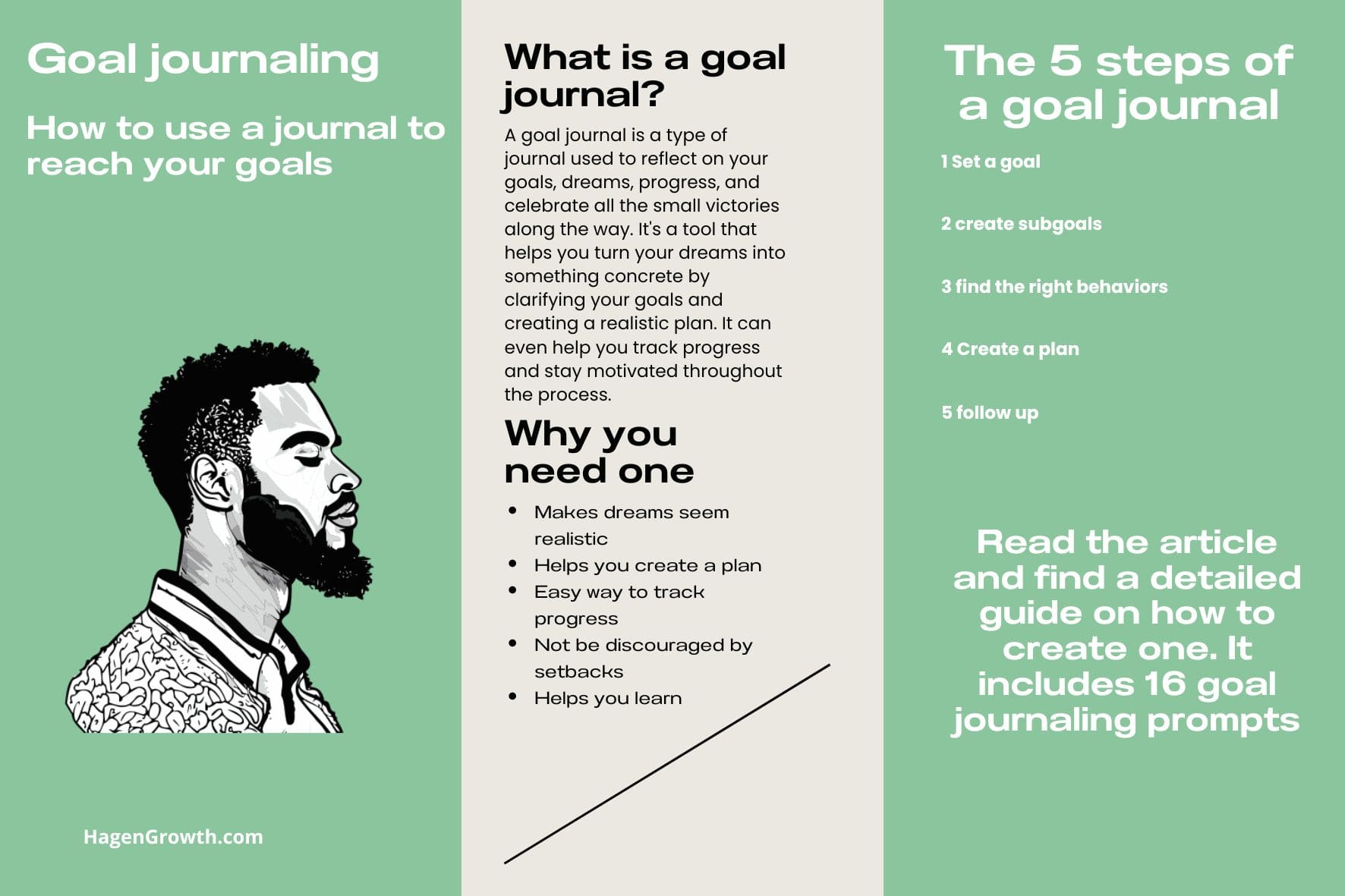
A goal journal is a type of journal used to reflect on your goals, dreams, progress, and celebrate all the small victories along the way. It’s a tool that helps you turn your dreams into something concrete by clarifying your goals and creating a realistic plan. It can even help you track progress and stay motivated throughout the process.
A goal journal is a great tool for anyone who have a dream but aren’t sure how to reach it yet.
Why you need a goal journal
A goal journal is a crucial journaling technique for anyone who dreams about achieving something. Let’s have a look at 5 reasons why you need one.
1. Goal Journals can make your dreams seem realistic
Most people have big dreams. They dream about getting in shape, starting their business, advancing in their career, or excelling in their studies. They have these dreams, but they often seem distant, almost unrealistic. To avoid failure and disappointment, they rarely let it get past the dream stage. Most people don’t reach their goals.
A goal journal is a tool that can help you take your dreams and make them concrete. Suddenly, they begin to seem realistic. It might still look difficult, but you know with the right steps, it’ll be possible. Once you’ve truly realized this, the fear of failure will shrink, and you’ll be more likely to go and achieve it.
Related: How to stop overthinking
2. A goal journal can help you make a plan
A goal journal helps you identify your goals. It gives a clear picture of how your end destination looks and what you have to do to get there.
It’ll be easy to create a plan once you know what your goal looks like and what you need to do to get there. Later in this article, we’ll discuss how you can do that.
3. You can track your progress and stay motivated
When you’re working on long-term goals, you’ll have periods where it feels like you’re getting nowhere. These periods are often discouraging, and without the right tools and techniques, it might be where your dream dies.
A goal journal can help you track progress with something called subgoals. Subgoals are milestones you have to reach on your way to your goal. You can use these to track your progress by seeing if you’re reaching them when you should.
Remember, not much will improve in one day. But when you stick with your plan and let those single days accumulate. You’ll get far. Your life can look completely different in months by doing something small every day.
Related: Gratitude journal
4. Help you to not get discouraged by set backs
Most times, when we’re trying to reach a goal, it can feel like two steps forward and one step back. Something improves until suddenly it doesn’t. It’s an inevitable part of most plans but can feel discouraging.
When this happens, your situation might look worse than it did yesterday. But as you look back on your subgoals, you’ll quickly notice that you’re further, even with the setbacks, than you were yesterday. This will help you not get discouraged by this. You might even use the journal to look back at how you recovered in the past and do it again.
Related: Journaling for stress and anxiety
5. Helps you learn
A goal journal can help you learn about yourself and whatever you’re trying to achieve. At first, it’ll help you understand yourself better by mapping out what you really want to achieve. Later, it’ll teach you about the subject by allowing you to analyze your successes and setbacks. It helps you understand what works and what doesn’t.
You can use this knowledge for further personal growth or to ensure success in future projects. You might even use it to help others in a similar situation succeed, just as I’m trying to do here on Hagen Growth.
Related: Self-awareness to help you understand how your changes are affecting you
How to start a goal journal
There are several ways to keep a journal. All have different benefits and drawbacks, but all can be an effective tool for reaching one’s goals.
The following is the approach I usually use when working on a new goal. It consists of 5 different stages you can revisit as often as you need to. Below is a description of each step with a short and simplified example of how it could look.
1. Write down your goal(s)
The first thing you should do is identify your goal. Describe what it is you want to achieve in as much detail as possible. What is it, how would it look, when should you reach it, and anything else that might be relevant to your situation. The better you can describe this, the easier the next steps will be.
A great tool for setting these kinds of goals is something called a SMART goal. You can find a guide on how to create one here.
Related: Identity based habits
Example
I want to get in better physical shape, so I feel better about myself and can be more productive. I want to lose 10lbs within 10 weeks.
2. Create subgoals
Subgoals are small milestones you’ll reach on your way to your goal. They are a great tool for staying motivated, tracking progress, and accumulating small wins.
To set some for yourself, you have to break your goal into smaller goals and add a date for when to reach them. I’ll show you how it can look in the example below.
Example
For my goal of losing 10 lbs in 10 weeks, I’ll set the following subgoals:
- Lose 2 lbs. Should be completed within 2 weeks
- Lose 4 lbs. Should be completed within 4 weeks.
- Lose 6 lbs. Should be completed within 6 weeks
- Lose 8 lbs. Should be completed within 8 weeks.
3. What do you need to do to reach your sub goals?
Now that you have your sub-goals, it’s time to find the behaviors you need to reach those. Take one sub-goal at a time and write everything you need to do to reach it. It’s okay if you write the same behavior under several goals. You’ll organize the list later. At this stage, you won’t have to prioritize. Just write the behaviors down as they pop into your head.
At this stage, it’s time to look at which behaviors you need to reach your goal. This step can be divided into two parts. In step 1, you’ll focus on what you have to change in your life to achieve your goal. I call these macro behaviors. In step 2, you’ll focus on which behaviors will make these changes possible. I call these micro behaviors.
Step 1
In the first step, we’ll focus on which macro behaviors you need to achieve your goal. These behaviors are broad and often contain more than one habit.
Example
To reach my subgoal, i need the following macro behaviors:
- Follow a workout routine
- Eat healthier
- Have a reasonable sleeping schedule
- Increase non-exercise activity
Step 2
In step 2, we’ll focus on finding the micro behaviors needed to change the macro behaviors. These habits are often more specific and require fewer steps.
To do this, you need to take each behavior from above and write down all the needed behaviors to achieve this below.
Example
Follow a workout routine
- Get a workout routine
- Buy equipment/a gym membership
- Create a workout habit
Eat healthier
- Cook dinner at home
- Add vegetables to my meals
- Eat fruits as a snack instead of junk food
Create a reasonable sleeping schedule
- Try to get 7+ hours of sleep every day
- Improve sleep hygiene
Increase non-exercise activity
- Take the stairs when possible
- Walk/bike whenever it’s possible
Related: The best habits for self-improvement
4. Put together a plan – How are you going to approach this?
Now that you know what you have to do, it’s time to put the behaviors together and create a plan. Note at what stage you’ll start doing the different behaviors and when to do what. If possible, planning all the way to the end creates the best conditions for success. However, for some people, this might seem overwhelming. If this is the case, planning how you’ll start and then planning one week at a time might work better.
It’s important to remember that you shouldn’t be doing all the new behaviors from day 1. If you did, you’d most likely feel overwhelmed and never reach your goal. It’s better to slowly implement a few new behaviors and let them become a habit before changing more.
The example below is a simplified version of the plan I would create if all the behaviors were new to me. In reality, fewer or slower changes might work better. To help create structure, I have used my subgoals.
Learn more about how you can reach your goal with our course “The Blueprint to Reaching any Goal“
Example
I have created the following plan to help me reach my goal within the timeframe. I should keep the earlier behaviors every time I go into a new stage.
Week 1-2
- Get a workout plan.
- Get a gym membership.
- Begin to create the habit of working out
Week 3-4
- Begin to improve sleep hygiene.
- Take the stair when possible
Week 5-6.
- Start to cook at home
- Bike or walk when possible
Week 7-8
- Focus on getting 7+ hours of sleep every night
- Add vegetables to all meals
Week 9-10
- Bike or walk when possible
- Replace snacks with fruit
Depending on who you are, you might benefit from setting durations and small objectives for each stage. This is just a loose example to show you how it can look.
5. Follow up
You know what you want, you’re plan is ready, and you’ve started working towards your goal. But this doesn’t mean you should let your goal journal go already.
The first 4 steps were just the beginning. The final step of the journal is the longest but most important. Here, you’ll follow up on your plan. You can use it to notice and celebrate progress, learn from your experiences, and readjust your plan if necessary. Exactly how you do this depends on your initial goal and plan.
Related: How to increase productivity with a journal
Example
To figure out what’s working and what isn’t, I will answer the following questions.
- How do I feel?
- What’s going well?
- What’s not going well?
- How can I improve the things not going well?
- Am i reaching my subgoals?
- Is the plan working?
I would use these things to analyze my plan. If something isn’t working for me, I would go back and readjust my plan.
Related: Journaling for problem solving
Tips for reaching your goals with a goal journal
You should now understand what a goal journal is and how to create and use one. Let’s have a look at a few tips for increasing your chance of success.
1. Start slow.
The biggest mistake people make when creating their goal journal and beginning to work on their plan is to start too fast. They want to reach their goals as fast as possible and try to make an explosive start. They do a lot from day 1, but one of two things tends to happen soon.
At some point, you’ll hit a plateau or a difficult period. If you’re already doing everything you can and more, it’ll be difficult to handle this. There are a few things you can change, and you know that you aren’t able to increase effort. This tends to kill motivation and only a few get past this.
The second thing that might happen is burnout. A habit doesn’t form from day 1, and it requires more effort until it does. The drastic increase in workload from one day to another is too much for most. They won’t be able to handle it and burn out.
The best way to create change is to do so slowly. Slowly work on creating new habits and increasing your workload over time. When you give yourself time to adapt, you create a foundation for consistency which takes us to the second tip.
2. Stay consistent
Intensity isn’t the secret to success. Consistency is. It doesn’t mean that you have to put up top performances every day and constantly push yourself to the limit. It means that you continue to show up. Some days you might not do much, but you show up.
Don’t let yourself be discouraged if you miss a day. It won’t affect your long term results if you get back the next day.
Related: How to beat procrastination
Goal journal prompts
The type of goal journal described above requires a lot of effort and isn’t for everyone. An alternative is to use prompts and create your own version. Below are 16 goal journaling prompts you can use.
- What are my short-term goals? How can my reach them?
- What are my long-term goals? How can my reach them?
- What scares me about my goals? Why is it worth it to push past my fears?
- What would I do if I could do anything in life?
- What is stopping me from doing what I truly want?
- What are my best qualities or skills?
- What are my top 4 priorities?
- Are my lifestyle aligned with my goals? If not, what can I do to fix this?
- What can I accomplish in the next month?
- What can I accomplish in the next year?
- What can I accomplish in the next 5 years?
- What can I accomplish in the next 10 years?
- What is my biggest dream? Why do I want this?
- Am I holding on to goals that doesn’t fit me anymore? Have I let go of dreams in the past?
- How does my ideal future look? Is it realistic?
- Why is it worth it to pursue my goals?
Related: 39 journal prompts to boost productivity
Final thoughts
Hard work without a plan, and a plan without hard work isn’t worth much. A goal journal can help you create a plan for how to reach your goals, so you just need the hard work.
Reaching goals might be a long and difficult process, but if you really want it, it’ll be worth it. Stay patient and do something good for future you.
What to read about next

- Mindset and Discipline: The Foundation of Sustainable Change - March 4, 2026
- Thinking Vs. Reflection – What is the difference? - February 20, 2026
- Why we do things we later regret – and how to interrupt the pattern - February 13, 2026