
It’s easy to look at someone’s success and only see the visible result. The body, the business, the confidence, the discipline, the finished project. But what we don’t see is everything that came before it: the repeated effort, the difficult days, the small choices, and the thousands of small wins that slowly built the result over time.
In this article, we’ll look at what small wins are, why they matter, how to use them, how to celebrate them, and examples of small wins in different areas of life.
Key points
- Small wins are small actions, choices, or victories that move you closer to your goals and the person you want to become.
- They matter because they make progress visible, build self-trust, create momentum, and help you stay with the process before the bigger result arrives.
- A small win does not need to be impressive to count. It only needs to move you in the right direction.
- Small wins work best when you notice them, track them, celebrate them, and use them to build from one win to the next.
What are small wins?
Small wins are small victories that align with your goals and the person you want to become. They are proof that you are moving in the right direction, even when the progress is too small to see yet.
A small win is not always impressive on its own. It can be a small action, a better choice, or a moment where you do what you said you would do. But when these wins accumulate, they begin to change your situation, your self-trust, and the way you see yourself.
They can be related to habits, physical performance, work, personal goals, or anything else you are trying to improve. Every time you do something that brings you closer to where you want to be, it can count as a small win.
For example:
- If your goal is to get in shape, replacing one snack with a healthier alternative or doing a short workout you otherwise would have skipped is a small win.
- If your goal is to read more books, reading one page is a small win.
- If your goal is to become more consistent with your work, showing up and doing the bare minimum to keep momentum alive on a difficult day is a small win.
On their own, these actions may not change much, but repeated over time, they become something bigger. They create progress, reinforce your identity, and give you evidence that you are becoming the kind of person you are trying to become.
This is also a central part of the Hagen Growth philosophy: meaningful change is built through the small actions you repeat, not just the big moments you chase.
Why small wins matter
Small wins are a central part of sustainable change, but they are easy to overlook because they get overshadowed by the bigger result at the end.
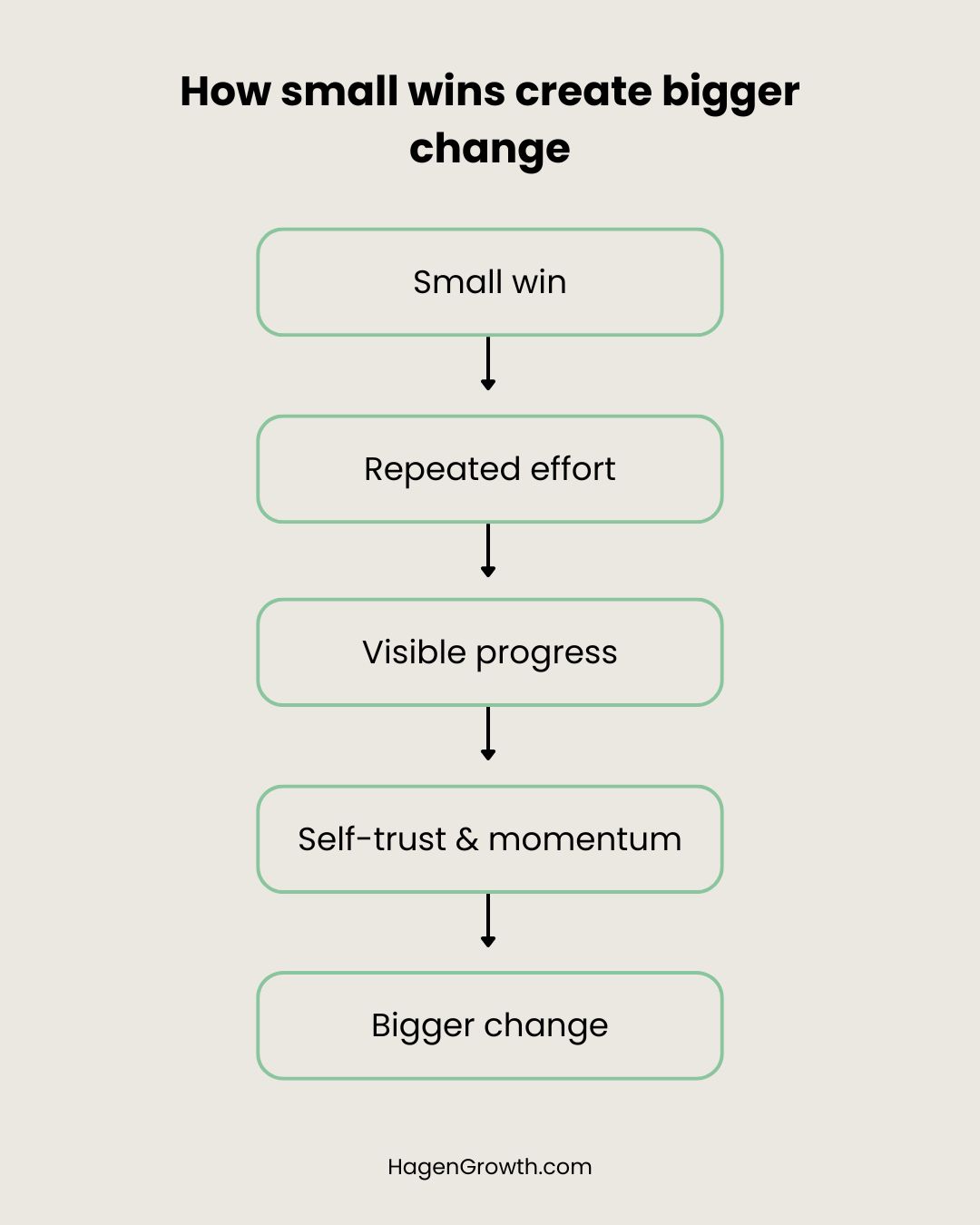
But the big result is rarely one single breakthrough. Usually, it’s the result of repeated small wins that slowly change what you do, how you feel, how you see yourself, and where you end up. Here are five reasons why small wins matter.
1. Big changes are built from small wins
Going to the gym once, working on your business for 30 minutes, or eating an apple instead of a cookie will not change much by itself.
But each of these actions is still a small win. It’s a positive vote for the person you are trying to become, and when these small victories are repeated consistently, the results slowly move from invisible, to noticeable, to significant. Every big achievement is built this way.
The bodybuilder does not build their physique from one workout. The business owner does not build something meaningful from one focused work session. The successful student does not improve from one day of studying. They accumulate small wins over time.
2. Small wins make progress visible
When you work on a long-term goal, progress is often too slow to notice in the moment. You may be doing the right things, but the visible result is not there yet. Your body has not changed much. Your work has not paid off yet. Your confidence does not feel different. Your habits still feel fragile.
Small wins make progress visible before the final result arrives. Every time you collect a small win, you get evidence that you are doing the work that creates change. Even if you can’t see the outcome yet, you can see the behavior that leads to it.
This is especially important during difficult periods. When motivation fades, life gets stressful, and the goal starts to feel far away, it is easy to believe nothing is happening. Small wins help you keep going here, because they remind you that progress is not only measured by the final result but also by whether you keep showing up.
3. Small wins build self-trust
Self-trust requires proof. It comes from doing what you said you would do, especially when things are difficult or you do not feel like it.
If you only view the end goal as real success, it becomes easy to erode self-trust. Every imperfect day feels like a failure, every scaled-back effort feels like a miss, and every setback becomes evidence that you are not doing enough. Small wins change that.
When you treat small victories as real wins, you start collecting positive proof instead. Showing up with a smaller version counts. Doing something instead of nothing counts. This matters even more if you already struggle with low self-trust.
When you repeatedly prove to yourself that you can show up, even in small ways, you slowly begin to trust yourself more. That changes how you feel about yourself, but it also changes how likely you are to keep going long enough to reach the bigger goal.
Self-trust is built through the small promises you keep when quitting would be easier
4. Small wins create momentum
Small wins create a sense of momentum. One small win makes the next one feel slightly easier. Then the next and the one after that.
Over time, the right behavior starts to feel more natural. You need less willpower to continue. Good decisions become easier to repeat and the habit starts feeling less like something you are forcing and more like something you are becoming.
This doesn’t happen immediately, but it builds with repetition. Small wins create the momentum that makes consistency easier.
5. Small wins help you enjoy the process
Most meaningful goals take longer than we want. If you only allow yourself to feel successful when the final result arrives, the process becomes heavy. There is too much waiting, too much pressure, and too little positive feedback along the way.
Small wins make the process easier to stay with. Instead of beating yourself up for not doing a full workout, you can recognize that you still showed up on a difficult day. Instead of waiting for perfect conditions, you can respect the fact that you gave what you had.
That doesn’t mean lowering your standards or accepting mediocrity. It means being honest about your current circumstances and recognizing the wins that keep you moving. Some days, 20% is all you have. On those days, doing the 20% instead of doing nothing is a win worth noticing.
The process becomes easier to stay with when you learn to recognize progress before the final result arrives
How to use small wins
Small wins are simple in theory: if a behavior moves you closer to where you want to be, and the alternative would move you less or not at all, it can count as a win. But in practice, it can be difficult to use small wins properly.
Here’s how to use small wins in a way that actually helps you reach your goals.
1. Decide what counts as a win
You need to decide, or at least have an idea of, what counts as a small win for you. Many people discredit their small wins because they expect them to look bigger. They think they should have done more, pushed harder, or completed the full version of the task, but that often misses the point.
A small win should move you in the right direction. What that looks like depends on your goals, your situation, and what you’re currently struggling with.
For me, the smallest version of a few important wins could look like this:
- With workouts, I count it as a win if I do the main exercise for each planned major muscle group on a day I otherwise would have skipped or pushed myself too hard.
- On the bike, a small win can be 30–45 minutes of light spinning on a day I otherwise would have skipped.
- With Hagen Growth, it can be writing one section of an article if my head can’t do more.
- With my studies, it can be going through the presentation instead of going to class.
The full version of these behaviors still counts as a win. But the scaled-back version also counts, especially when the circumstances are harder. Sometimes the smaller version is actually the more important win, because it keeps the pattern alive when quitting would have been easier.
2. Track them
A simple way to notice and use small wins is to track them. This can be as simple as tracking consistency, progress, or completed tasks. The point is not to make tracking complicated, but visible.
When you track your small wins, you create proof of the effort you are putting in. You can see that you are showing up and that the wins are accumulating.
That makes the small win more powerful, because it is no longer just a feeling in the moment. It becomes visible evidence. A simple habit tracker, journal, checklist, or progress log can be enough.
3. Celebrate them
Small wins work better when you actually treat them as wins. If you do the right thing, but immediately dismiss it as “not enough,” you lose a lot of the value. The behavior still helps, but you don’t get the same boost in self-trust, confidence, or momentum.
That is why celebration matter, and it doesn’t have to be something big.. Sometimes it’s enough to pause for a moment and acknowledge that you did something good for yourself – especially on days where you had to fight yourself to do it.
Tell yourself that it counted. Recognize that it was a positive vote for the future you are trying to build.
4. Use them when motivation is low
Small wins matter most when motivation is low. When life is easy, energy is high, and your routine is working, it’s usually not that hard to collect wins. But when you are tired, stressed, overwhelmed, or discouraged, the smaller wins become much more important.
This is where many people make the mistake of thinking the small version doesn’t count. But showing up with a smaller version can be the thing that stops you from slipping further. It keeps the pattern alive and gives you proof that you are still in it. Over time, those small wins can help rebuild momentum until things feel easier again.
So when motivation is low, don’t ignore small wins. Lower the floor, claim the win, and keep moving.
5. Build from one win to the next
A small win does not have to change everything by itself. Its real power comes from what it leads to next.
One small win can make the next one easier. Then the next and the one after that. Over time, you are not just collecting isolated actions, but building a pattern. That pattern is what changes things.
It can change how consistent you are, how much you trust yourself, how you see your own identity, and eventually, it can change the situation you are in. So don’t treat a small win as the end. Use it as the next step. Claim the win, then build from it.
The small thing today might not look like much, but repeated enough times, it becomes the change
How to celebrate small wins
Celebrating small wins is an important part of making them matter. If you do something good for yourself but immediately ignore it, the action still counts. But you miss some of the positive effect it could have had on your self-trust, motivation, and momentum.
The challenge is finding the right balance. You want to acknowledge the win without making the celebration bigger than the action itself. Here are a few simple ways to celebrate small wins.
Pause and acknowledge it
Sometimes the best celebration is simply taking a moment to notice what you did. Tell yourself that it counted and recognize that you did something good for yourself. Let the win get attention instead of rushing past it like it meant nothing.
Write it down
Writing the win down makes it more tangible. You can write it in a journal, tracker, checklist, or notes app. It doesn’t have to be complicated. The point is to turn the small win from a passing feeling into visible proof that you are moving.
Share it with someone
If you have someone who supports you, sharing a small win can make it more powerful. It gives the win social reinforcement. Someone else sees the effort, recognizes it with you, and helps make it feel more real.
This only works if the person actually respects what you are trying to do. Don’t share your small wins with someone who will make you feel stupid for caring.
Use a small reward
A small reward can work well, especially if the win took effort. The reward doesn’t have to be big. It could be a quiet break, a good coffee, a walk, an episode of something you enjoy, or anything else that feels good without working against your goal. The point is to connect the win with something positive.
Common mistakes with small wins
Small wins are simple, but people still use them in ways that make them less effective. Sometimes they ignore the win because it feels too small, sometimes they only count perfect days, and sometimes they celebrate in ways that quietly work against the goal. Here are three common mistakes to avoid.
1. Thinking the win is too small to count
Many people think their wins are too small to count. They think the result should be bigger, the effort should have been better, or the action was just something they should have done anyway. But that misses the point.
Small wins are supposed to be small. They’re the small effort on a difficult day, the minimum useful action when energy is low, and the repeated behaviors that slowly build into something bigger. A win doesn’t need to be impressive to count. It needs to move you in the right direction.
2. Only counting perfect days
Another mistake is only counting the days where everything goes according to plan. After you define what counts as a small win, it is easy to turn that into the new minimum. But circumstances change. What feels easy on a good day can be everything you have on a hard day.
The small wins also count when you scale the habit down instead of skipping it completely. They count when you prioritize rest instead of pushing yourself into burnout and when you find a lower floor because life temporarily makes the full or even the simple version unrealistic.
3. Using rewards that work against the goal
Celebrating small wins is important, but the celebration should not cancel out the win. Some people reward themselves in ways that actively work against their goals. That slows progress and can quietly erode self-trust, because deep down you know the reward wasn’t really supporting the process.
If your goal is to lose weight, rewarding yourself with a binge probably isn’t worth it. If your goal is to build consistency with your work, writing one paragraph today doesn’t mean tomorrow should become a full day of avoidance.
A reward should support the process, not become an excuse to step away from it. Don’t let celebration turn into self-sabotage.
Small wins examples
As you’ve seen in this article, small wins can look different depending on your goals, circumstances, and what you’re currently struggling with.
For one person, going to the gym might be a normal part of the day. For another, it might be a major win because they have been stuck, tired, or inconsistent for weeks.
That’s why a small win is about what the action means in your situation. Here are some examples of small wins in different areas of life.
Personal small wins examples
Personal small wins are often the simple things that make you feel like you are taking responsibility for your own life.
They might not look impressive from the outside, but they matter because they help you regain control, build self-trust, and prove to yourself that you can do the basics.
Examples of personal small wins include:
- Getting out of bed on time
- Cleaning your room
- Going for a walk
- Choosing not to scroll for another hour
- Having a difficult conversation
- Doing what you said you would do
These wins are easy to overlook because they aren’t dramatic. But if they move you away from avoidance and closer to the person you want to become, they count.
Health and fitness small wins examples
Health and fitness are built almost entirely through small wins. One workout will not change your body. One decent meal will not fix your health. One night of better sleep will not solve everything. But repeated often enough, these small actions start to accumulate.
Examples of health and fitness small wins include:
- Going to the gym
- Eating a decent meal
- Drinking enough water
- Going to bed earlier
- Stretching for five minutes
- Choosing the better option when eating out
The win is not always that you did something perfectly. Sometimes the win is that you chose the better option when the worse option would have been easier.
Work and study small wins examples
Big projects often feel overwhelming because we focus on the full result instead of the next step. Small wins help make progress more visible. They give you something concrete to complete, even when the bigger goal still feels far away.
Examples of work and study small wins include:
- Starting a task you’ve avoided
- Writing one paragraph
- Sending one important email
- Studying for 20 minutes
- Planning tomorrow
- Finishing one small part of a bigger project
These wins matter because they break resistance. Once you start, the task usually becomes easier to continue.
Habit small wins examples
Habits are one of the clearest examples of small wins because each repetition is a small vote for the kind of person you are trying to become. You don’t need a perfect streak for the habit to matter, but enough small repetitions to make the behavior part of your life.
Examples of habit small wins include:
- Doing a habit for one more day
- Using the 2-minute rule to get started
- Tracking a habit
- Avoiding one bad habit
- Preparing your environment for tomorrow
A habit small win is not just about the action but about reinforcing the pattern. Every time you repeat the habit, you make it a little easier to repeat again.
Final thoughts
Small wins are not just small achievements. They are evidence of how you live, what you repeat, and the direction you are moving in.
As they accumulate, they begin to change more than your results. They change what you believe is possible, how you see yourself, and what your life slowly becomes.
So start recognizing your small wins. Acknowledge them as something important, not because they change everything today, but because they are part of what gets you to the bigger things later.
The small thing today might not seem like much. But without enough of those small things, the bigger goal never happens.
Further reading

- Mindset and Discipline: The Foundation of Sustainable Change - March 4, 2026
- Thinking Vs. Reflection – What is the difference? - February 20, 2026
- Why we do things we later regret – and how to interrupt the pattern - February 13, 2026