
Most habit advice is written for people who live in a perfect vacuum. It tells you to “just be more disciplined,” wake up at 5 AM, and rely on pure willpower to change your life.
But motivation is a fragile strategy. In the early days of building Hagen Growth, I fell into this exact trap. I tried to force perfect output every single week, regardless of how chaotic my schedule actually was. During quiet, ideal periods, pure discipline worked. But the second life got tough or the business demanded more energy elsewhere, the entire system crumbled. Instead of scaling back to a minimum viable routine, my habits broke completely, and I would fall off for weeks at a time before returning.
When willpower inevitably runs out, you do not rise to the level of your goals. You fall to the baseline of your automatic behaviors.
You don’t fail to build good habits because you lack discipline. You fail because your daily actions are misaligned with your identity, and your environment is built for failure. If you want to stop starting over every single Monday, you have to stop trying to “want it more” and start acting like an architect of your own life.
Key points
- The discipline delusion: Motivation is a fragile strategy. You do not rise to the level of your goals – you fall to the baseline of your habits.
- Environment beats willpower: You cannot out-discipline a bad environment. Building a good habit is about engineering the path of least resistance – breaking a bad one requires killing the trigger.
- Target the dominos: Stop trying to change everything at once. Focus on keystone habits – the core behaviors that automatically create a positive ripple effect across the rest of your life.
- Standardize before you optimize: Start impossibly small. The goal of habit formation isn’t flawless perfection, it’s fast recovery. Never miss two days in a row.
What is a habit?
Habits are repeated actions that, over time, have become automatic and unconscious. They range from simple impulses – like scrolling through social media – to complex routines, like your diet or how you handle stress.
People do not decide their futures. They decide their habits, and their habits decide their futures.
F. Matthias Alexander
According to researchers, roughly 40% of your daily behavior is completely unconscious. You are the sum of these automatic actions. You will never grow beyond what your habits allow. In the Hagen Growth philosophy, habits are the physical output of your identity. If you want to change who you are, you must first change what you do automatically. Read the full Hagen Growth philosophy here
The 3 Steps of Habit Formation (The Habit Loop)

You cannot change what you do not understand. For a behavior to become a habit, it must cycle through three distinct stages: the Cue, the Routine, and the Reward. Every time this loop is completed successfully, the behavior becomes harder to break.
Here is how a negative habit, like stress-eating, fits into this framework:
1. The Cue
The cue is the trigger. It is the signal that prompts your brain to shift into automatic mode. Cues are typically driven by an emotion, a specific time of day, a physical location, or a preceding action.
Most people try to fix the wrong habit because they misidentify the cue. They think their trigger is hunger, but it is actually client stress or mid-day boredom. If you don’t audit the real cue, your system will always fail.
- Example: You experience a sudden spike in stress, which immediately triggers a craving for comfort.
2. The Routine
The routine is the response to the craving. It is the physical, mental, or emotional action you take to address the cue. This is the stage most people mistakenly view as the entire “habit.”
- Example: In response to the stress, you begin binge-eating snacks.
3. The Reward
The reward is the payoff. It delivers a sense of pleasure or alleviates pain, which tells your brain that this specific loop is worth remembering for the future. Once the reward is delivered, the loop closes. Your brain logs the connection between the cue and the reward, making the action more automatic the next time the cue appears.Example: The food provides a temporary sense of relief and distraction from the stress.
The Two Types of Habits That Matter Most
There are thousands of micro-behaviors you could try to optimize, but treating them all equally is a mistake. To build a sustainable foundation for growth, you only need to focus your energy on two specific types of habits.
Identity based habits
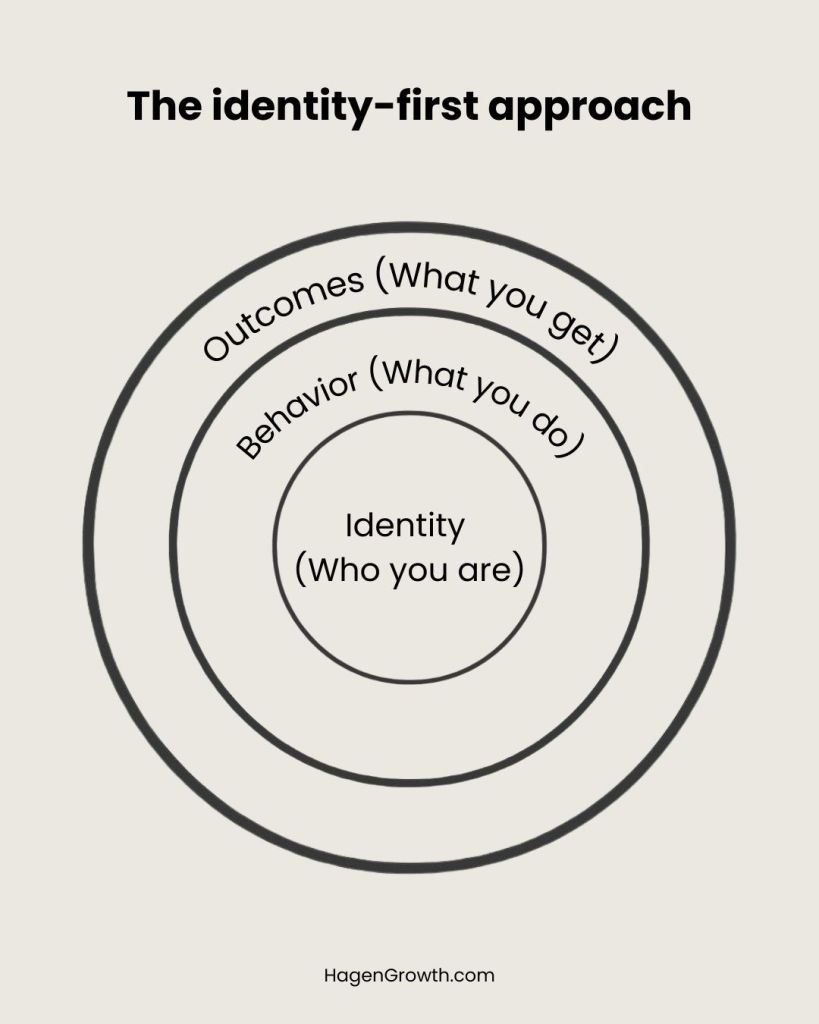
Identity-based habits are formed not to achieve a specific outcome, but to prove a new identity to yourself.
Most people try to change their behavior by focusing entirely on the goal – losing weight, building a business, or reading a certain number of books. That approach relies heavily on motivation. True behavior change starts with the identity you want to adopt. Every action you take is a vote for the type of person you are becoming.
When you stop trying to “read more” and start identifying as “a reader,” the habits that support that identity stop causing internal friction. They simply become your default.
Read more: The complete guide to building Identity-Based Habits here
Keystone habits
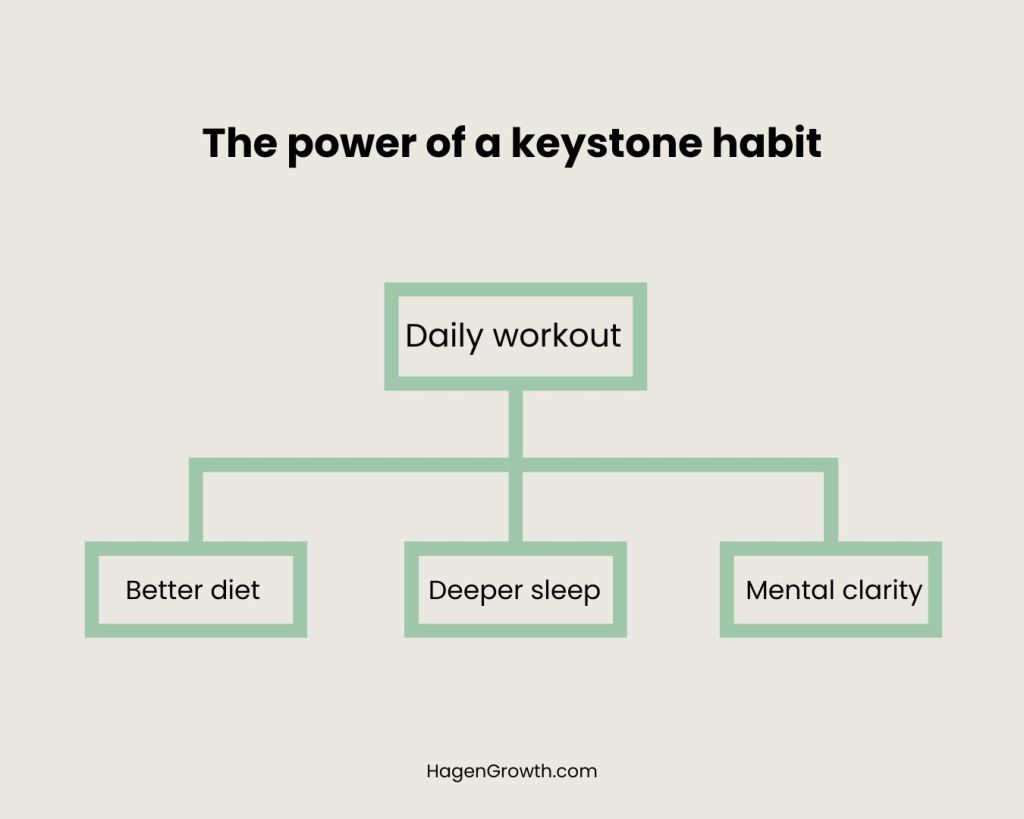
Keystone habits are the structural pillars of your routine. They are the “domino” behaviors.
When you establish a keystone habit, you do not just change one thing – you automatically trigger a ripple effect of other positive behaviors. But the reverse is also true. When I moved to Thailand, I let go of my most important keystone habit: working out. The collapse was fast. Because I stopped training, my diet deteriorated. Because my diet deteriorated, my sleep was deprioritized. The good habits that made me feel like me slowly unraveled until I could barely recognize myself, neither physically nor mentally.
It wasn’t until I started working out again that my baseline identity slowly returned. That is the power of a keystone habit. If you want the highest return on your energy investment – and the strongest defense against your life unraveling when your environment changes – identify and protect your keystone habits first.
Read more: The deep dive on how to identify your Keystone Habits here
How to change your habits
You do not change a habit by relying on willpower; you change it by altering the system around it. If you want to take control of your habit loops, you have to redesign your environment and manage friction.
How to Build Good Habits
Building a good habit is not about trying harder. It is about engineering the path of least resistance and making it as easy and rewarding as possible. Here are three mechanical ways to program a new behavior into your daily routine:
Habit stacking
Habit stacking is the process of tying a new behavior directly to an existing one. Instead of relying on motivation or a specific time of day, you use an established habit as your Cue. If you already drink a cup of coffee every morning, you “stack” your new habit (like journaling for 5 minutes) immediately after it. Over time, the completion of the original habit becomes the trigger for the new one.

The 20-second rule
The 20-second rule is about ruthless friction reduction. It dictates that you must make your desired behavior take less than 20 seconds to start. This ties directly into Layer 4 (Friction) of your daily systems. If you want to read more, leave the book on your pillow. If you want to work out, pack your gym bag the night before. By removing the physical and mental friction between you and the action, you eliminate the window of time where you can talk yourself out of it.
Temptation bundling
Not all good habits deliver an immediate, pleasant reward – especially in the beginning. Temptation bundling solves this by pairing an action you need to do with an action you want to do, artificially inflating the Reward stage of the habit loop. For example, only allow yourself to listen to your favorite podcast while you exercise. By tying a guaranteed positive reward to a difficult task, you reprogram your brain to look forward to the work.
How to Break Bad Habits
Every bad habit serves a purpose. You do not scroll mindlessly or stress-eat by accident. Your brain is seeking a specific reward. To break a destructive loop, you have to remove the mechanics behind it.
You cannot out-discipline a bad environment. If you want to kill a bad habit, stop relying on willpower and start acting like an architect.
Remove the cue (Environment design)
The easiest way to stop a bad habit is to remove the trigger entirely. This is pure environment design (Layer 1 of your Systems framework). If you struggle with binge eating, do not keep comfort food in the house. If social media is a distraction, delete the apps from your home screen. By eliminating the visual cue, you disrupt the habit loop before a craving even begins. You shift the friction, making the bad habit simply too much work to execute.
Replace the routine
You cannot just “stop” a bad habit; your brain will still crave the reward. The most effective strategy is to find a healthier routine that delivers the exact same emotional payoff. If your bad habit is scrolling to relieve boredom, replace the routine with reading. If you smoke to relieve stress, replace the routine with a walk. This takes trial and error, but once you find a positive action that satisfies the original cue, the destructive habit loses its power.
The 10 minute rule
When a strong craving hits, do not rely on willpower alone to say “no.” Instead, commit to waiting just 10 minutes. Set a timer. When it goes off, you can choose to give in, or you can choose to walk away. Often, the intensity of a craving peaks and fades within that brief window. By sitting with the discomfort, you teach your brain that it is entirely possible to experience an urge without immediately acting on it.
Where Most People Fail (The Rules of Execution)
Building a system is only half the battle – the other half is surviving the friction of daily execution. When you set out to change your behavior, you will encounter resistance. Here are the four non-negotiable rules for making a habit stick:
The 66-day reality – how long it takes to form a habit
Forget the 21-day myth. Science shows that it takes an average of 66 days for a new behavior to become completely automatic, with complex habits taking anywhere from 18 to 254 days. It is going to feel difficult and clunky at first. That is not a sign of failure. That is the reality of rewiring your brain to accept a new default. Expect the timeline and push through the initial friction.
Start small
When you rely on high motivation, you attempt massive changes that you can’t sustain. You try to change your identity and your behavior on the exact same day. That is a delusion.
The key to building an unbreakable routine is to start impossibly small. Shrink your new behavior down until it takes two minutes or less to complete. If you want to run five kilometers a day, your only goal for the first two weeks is to put your running shoes on and walk to the end of the driveway. Do not worry about the physical results yet. You have to make the behavior normal before you can optimize the output. Prove to yourself that you are the type of person who shows up every single day, and increase the effort only when the friction is gone.
Success is the product of daily habits, not once-in-a-lifetime transformations. You have to standardize the behavior before you can optimize the output.
Track your efforts
Your brain is terrible at remembering consistency. A habit tracker removes the emotion and provides objective data on your execution. More importantly, checking off a daily box provides visual, undeniable proof of your new identity. It acts as an immediate micro-reward and a small win, reinforcing the habit loop on the days when the physical results are still invisible.
Never miss 2 days in a row
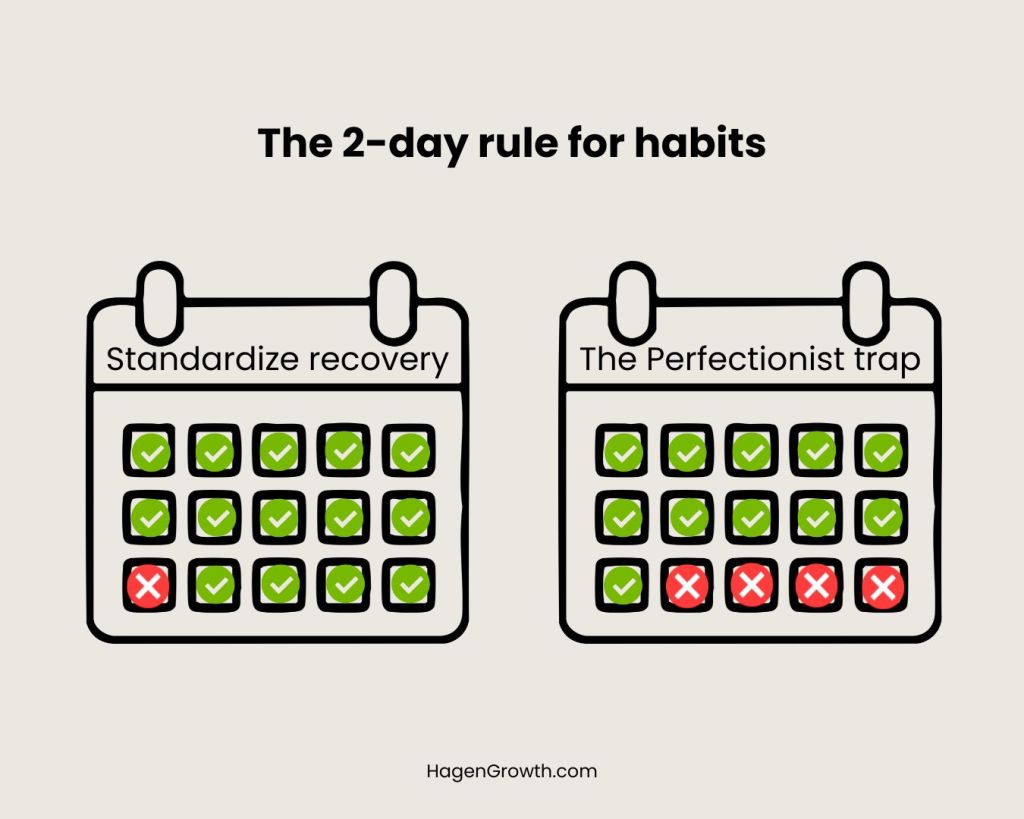
You will fail. A day will eventually come when your system breaks down and you miss a rep. How you handle that single failure determines everything.
For most of my teens and early twenties, I struggled with my weight because I was caught in the perfectionist trap. I would string together a few good days of eating, inevitably slip up, and the guilt would immediately take over. I would hit the “what the hell, it’s already ruined” phase, and one bad meal would spiral into weeks of falling back into old patterns.
When I returned from Thailand and needed to lose the weight I had gained there, I had changed the mindset. Over the 100 days it took to lose the weight, I had at least 10 days that could have completely derailed my progress – days where I overate or failed the plan. But instead of letting guilt define the project as a failure, I adopted a new mindset: One day doesn’t matter. I used the slip as data, recalibrated, and got back to my baseline the very next day.The goal of habit formation is not flawless perfection. It’s fast recovery. Missing one day is an isolated, meaningless event. Missing two days is the beginning of a new, negative habit. When you slip, your only priority is to make sure it does not become a slide.
Start Here: The 3-Step Habit Reset
Execution is everything when it comes to habit change. Do not attempt to overhaul your entire life by tomorrow. That approach relies on motivation, and motivation always fades. Instead, run this 3-step reset on exactly one behavior today:
1. Isolate one target habit Pick one keystone habit to build, or one destructive habit to break. Identify the single behavior that will create the largest positive ripple effect across the rest of your routine, and move you closest to your desired identity.
2. Identify the Cue and the Reward You must define the mechanics. If you are breaking a bad habit, what is the exact trigger starting it, and what is the payoff your brain is actually seeking? If you are building a good habit, what existing daily action will serve as your trigger, and what immediate payoff can you bundle with it?
3. Make good habits easy and bad habits hard Stop relying on willpower and start acting like an architect. If you are building a habit, eliminate all physical and mental friction so it takes less than 20 seconds to start. If you are breaking a habit, alter your environment to kill the cue and make the behavior incredibly difficult to execute.
Growth is not a product of intensity. It’s a product of consistency. Build the right structure, and your progress becomes completely predictable.
Further Reading: The Habit Archive
The Foundation (Core Systems & Mechanics)
The Rules of Time & Friction
- The 2-Day Rule
- How Long Does It Take to Form a Habit?
- The 21/90 rule
- The 2-Minute rule
- The 5-Minute Rule
- The 5 second rule
- The 10 minute rule
- The 20-Second rule
Habit Frameworks & Tracking
Specific Routines & Application
- How to form the perfect morning routine
- Habits for better sleep
- How to make exercise a daily habit
- How to make meditation a daily habit
- How to read more books
- 27 small habits that makes a big difference on your life
- The 9 Best Habits for Self-Improvement
Breaking Bad Behaviors & Productivity Fails
- How To Beat Procrastination
- Multitasking
- 10 Habits that will destroy your mental health
- Personal Productivity

- Mindset and Discipline: The Foundation of Sustainable Change - March 4, 2026
- Thinking Vs. Reflection – What is the difference? - February 20, 2026
- Why we do things we later regret – and how to interrupt the pattern - February 13, 2026